Event Rentals

Why Game Rentals Beat Photo Booths for Engagement Stats

September 12, 2026 By Event Fab Team 9 min read

Every brand team planning an activation eventually lands on the same question: do we put a photo booth in the corner, or do we build something guests actually play? Both photograph well. Only one of them reliably holds a guest in your footprint long enough for a brand ambassador to have a real conversation.

This is a dwell-time argument, not a taste argument. Below is how we think about the trade-off on the production side — what each format actually costs, what it demands from your floor plan and power plan, and how leaderboard mechanics change the math on engagement. If you are choosing between the two for a Q4 activation in New York, Connecticut, Massachusetts or Rhode Island, this is the conversation we would have with you at the site visit.
Key Takeaways

  • A photo booth transaction is short by design — queue, pose, print, leave. Games are built to be replayed, which is where dwell time comes from.
  • Leaderboards are the single cheapest upgrade to engagement: a persistent score turns a one-and-done interaction into a return visit.
  • Games need more floor and more sightline than clients expect — budget 10x10 to 20x20 per station plus a spectator lane, not just the cabinet footprint.
  • Photo booths still win on one thing: guaranteed take-home branded collateral and organic social distribution. The strongest activations run both.
  • Lead time is the real constraint. Stock rentals move in 2-3 weeks; custom-branded or custom-fabricated game builds want 6-8 weeks minimum.

What Each Format Is Actually Designed To Do

A photo booth is a transaction machine. The entire interaction is engineered to be fast: a guest steps in, poses for three to four frames, waits for a print, and walks away. That is the point — throughput. A well-run booth can process a long line without stalling the room, and it sends guests home with something physical that carries your logo.

A game is a retention machine. Cornhole, skee-ball, a claw machine, a basketball shootout, an oversized Connect Four, a racing sim — all of them are built around a loop: attempt, score, react, attempt again. The failure state is fun. That is the mechanical difference, and it is why the two formats produce such different engagement curves on the same floor.

When a client tells us they want “more engagement,” the follow-up question is always: engagement measured how? If the KPI is impressions and user-generated content, the booth is doing real work. If the KPI is conversations held, demos given, emails captured, or product actually placed in a guest’s hands, you need a format that keeps people standing still.

The Dwell-Time Gap, In Plain Numbers

Across the corporate activations we produce, the pattern is consistent enough to plan around. Here is what we typically see on our own floors:

  • Photo booth: roughly 60 to 120 seconds of guest-side interaction per party, plus queue time. Print-wait adds maybe another minute of standing around, and that wait is passive — guests look at their phones, not at your brand.
  • Single-play game station: roughly 3 to 5 minutes, depending on the format. A skee-ball or cornhole round runs short; a racing sim or claw machine runs longer.
  • Game station with a live leaderboard: frequently 8 to 15 minutes across multiple visits, because guests come back to defend or reclaim a position.

That last line is the whole argument. The leaderboard does not add time to a single play — it adds additional plays. A guest who scores well at 7:15 will check the board at 8:30 to see if they have been knocked off. That return trip is a second, unpaid-for chance for your team to talk to someone who has already self-identified as interested.

There is also a spectator effect that never shows up in a booth. People watch games. A three-person queue at a photo booth is dead time; a three-person queue at a basketball shootout is an audience, and audiences are where ambient brand exposure actually happens. Our broader thinking on this is in our guide to top corporate game rentals for team building, which covers format-by-format fit.

Leaderboard Mechanics: Getting Them Right

A leaderboard is not just a screen with names on it. Badly executed, it kills engagement instead of driving it — a board dominated by one unbeatable score at 6:45 tells every guest who arrives at 8:00 not to bother.

Reset windows

Segment the board by hour, or by session, or by team. A rolling reset keeps the top slot reachable all night. For multi-day trade shows, reset daily and award daily — otherwise day three is a ghost town at your best station.

Entry friction

Name capture is where most leaderboards break. If it takes a guest 45 seconds to type an email on a tablet before they can play, you have just reintroduced the photo-booth queue. Keep it to first name and last initial to play; capture contact details on the prize side, after they have already had a good time.

Visibility

The board needs to be readable from outside your footprint — that is the recruiting tool. We usually mount it high, in portrait, above the play surface, so it reads over guests’ heads from across the room. If your booth is under a low ceiling, that changes the rig entirely, which is a conversation to have before the CAD is locked.

Stakes

Something has to be on the line. It does not need to be expensive — top-of-hour prizes, a raffle entry per qualifying score, or a branded item that guests can see stacked behind the station. Visible inventory works better than an abstract promise.

Production Realities: Floor Plan, Power, and Crew

This is where the two formats stop being comparable line items and start being different production problems.

Footprint. A photo booth is honest about its size — 8×8 with a backdrop and you are close to done. Games are not. The cabinet or table is only part of it: you need a play lane, a queue lane, and a spectator lane. Plan 10×10 for compact tabletop formats and closer to 20×20 for anything with a throw, a swing, or a run-up. Clients who size a game station by the equipment spec sheet end up with guests backing into a bar rail.

Power and data. Booths are simple — one circuit, done. A leaderboard-driven game setup means scoring hardware, a display, and usually a local network so scores actually post. Venue Wi-Fi is not a plan. We bring our own network for anything score-driven, because the failure mode on a shared venue connection is a frozen leaderboard at peak, and a frozen leaderboard is worse than no leaderboard.

Crew. A booth runs with one attendant. A game station with prizes and score capture wants one attendant per station, and two if you are running a bracket. Labor is a real line item here and it is the one clients most often forget when they compare the two formats on price alone.

Venue constraints. In New York in particular, load-in windows and freight elevator dimensions decide what is even possible. A racing sim that will not fit a Midtown freight car is not a rental, it is a problem. We size every game build against the actual elevator and door schedule before it goes on a quote. The same discipline applies to our broader event game rental program — nothing gets specified until we know it can physically get to the floor.

Where the Photo Booth Still Wins

We rent both, and we would not push a client off a booth just to sell a bigger build. There are clear cases where the booth is the right call:

  • You need take-home collateral. A branded print is the only format that leaves your logo in a guest’s bag, on a fridge, or in a group chat. Games generate memories; booths generate artifacts.
  • You need organic social volume. Digital delivery with a pre-loaded caption and hashtag is a distribution channel. Leaderboards rarely get posted; a good GIF booth almost always does.
  • Your floor is tight. If you have 200 square feet total, a booth gives you a functioning activation. A game does not.
  • Your guest count is high and your window is short. A two-hour reception with 400 guests needs throughput, not depth. Games create bottlenecks under that pressure.
  • Your audience skews formal. Some rooms will not play. A gala crowd in black tie will step into a booth and will not step up to a shootout.

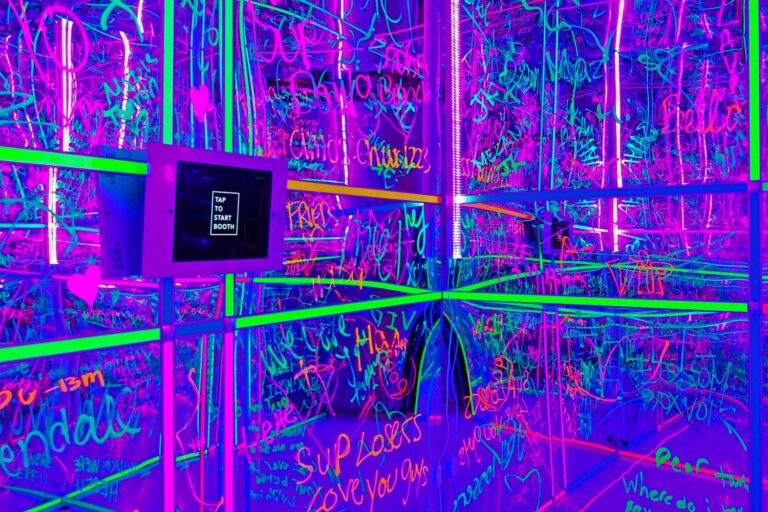
Our photo booth rental options cover open-air, enclosed, mirror, and roaming configurations, and the choice between them mostly comes down to ceiling height and how much of your backdrop you want in frame.

The Answer Is Usually Both — Sequenced Correctly

The activations that perform best do not pick. They run a game as the anchor and a booth as the exit, and they sequence the guest journey deliberately.

  1. Entry: something that draws from across the room — the game, with the leaderboard visible from the aisle.
  2. Middle: play, score, conversation. This is where your ambassadors work and where product demos actually land.
  3. Exit: the booth, positioned so guests pass it on the way out with a score to celebrate. A print captioned with their leaderboard position converts far better than a generic branded frame.

That sequence also fixes the booth’s biggest weakness. A booth placed cold at the entrance competes with a guest’s reason for being in the room. A booth placed after a win is a victory lap, and guests opt into it at a much higher rate.

Budget-wise, a dual-format footprint is usually less of a jump than clients expect, because the booth shares your existing branding, backdrop, and attendant coverage. The incremental cost is equipment and one head of labor, not a second activation.

Lead Times and What to Lock First

The decision between these two formats is cheap to make in week one and expensive to make in week five. Here is the realistic timeline:

  • Stock game rentals, unbranded: 2 to 3 weeks, availability permitting. Spring and December are tight across the Northeast — commit earlier than feels necessary.
  • Stock games with branded wraps and graphics: 3 to 4 weeks. Print and install need real time, and a rushed wrap looks rushed.
  • Custom-fabricated game builds: 6 to 8 weeks minimum. Design, CAD approval, build, test, and a load-in dry run all sit inside that window.
  • Leaderboard integration: add 1 to 2 weeks on top of the above if you want custom scoring logic, branded board design, or data capture that feeds your CRM.
  • Photo booth with custom branding: 2 to 3 weeks, mostly driven by print turnaround on the template and backdrop.

What actually breaks the timeline is not fabrication — it is approvals. Every week a wrap design sits in a stakeholder review is a week off the build schedule, and the build schedule does not stretch. Lock the format decision first, the branding second, and give yourself a hard internal deadline for graphics sign-off that sits two weeks ahead of the real one.

A photo booth measures how many guests you touched. A leaderboard measures how many came back.

Event Fab Team

Serving NY, CT, MA & RI

We produce game and booth activations across Manhattan, Brooklyn, Queens and the outer boroughs, throughout Connecticut and into Boston, the Cape and Providence. Every quote is sized against the real venue — freight elevator dimensions, load-in windows, ceiling height and available circuits — because a Midtown loft and a Newport waterfront tent impose completely different constraints on the same build. If your venue is locked, send us the floor plan and we will tell you what fits before you commit to a format.

Not Sure Which Format Fits Your Floor?

Send us your venue, guest count and run-of-show window. We will come back with a footprint plan, a realistic labor count and a lead-time schedule for both options so you can decide with actual numbers in front of you.
Request a Quote

Game Rentals vs. Photo Booths — Frequently Asked Questions

The questions brand and agency teams ask us most often when they are choosing between an interactive game station and a photo booth for a corporate activation.

Plan 8×8 for a standard photo booth including the backdrop. For games, budget 10×10 for compact tabletop formats and up to 20×20 for anything with a throw, swing or run-up. The mistake to avoid is sizing from the equipment spec sheet — you also need a queue lane and a spectator lane, and both are part of why the game works.

Yes, and it does not have to. Keep the play-side entry to first name and last initial so nobody waits. Capture email and company on the prize-redemption side, after the guest has already had a good experience. Opt-in rates are meaningfully higher at that point in the interaction than at the front of a queue.

We would not build a plan around it. Shared venue connections degrade exactly when your floor is busiest, and a frozen board at peak is worse than no board at all. We bring a local network for anything score-driven so the leaderboard stays live independent of house infrastructure.

Three to four weeks for stock games with branded wraps, and six to eight weeks for a custom-fabricated build. Add one to two weeks if you want custom leaderboard logic or data capture. The constraint is usually internal design approvals, not production — set your graphics sign-off deadline two weeks ahead of what you think you need.

In most cases, yes — positioned as the exit rather than the entrance. A branded print captioned with a guest’s leaderboard score converts far better than a generic frame at the door, and the booth gives you the take-home artifact and social distribution that games do not produce on their own.

One attendant covers a photo booth. A game station with prizes and score capture wants one dedicated attendant, and two if you are running a bracket or tournament. Labor is the line item most often left out when clients compare the two formats on equipment price alone.

Contact Us

Tell Us About Your Project Or Event

Which of our services are you interested in?*
Preferred Contact Method*
