Custom Bars

How Custom Bars Transform Corporate Cocktail Hours

May 12, 2026 By Event Fab Team 9 min read

Cocktail hour is the part of a corporate event that everyone remembers — and the part most internal teams under-plan. The room is half-strangers, attention is fragmented, and you have roughly 60 to 90 minutes to set the tone before the program starts. A well-built custom bar isn’t just a place to grab a drink. It’s the gravitational center of that hour: a branded set piece, a throughput engine, and the backdrop for every photo your social team will pull from the night.

Here’s what we’ve learned producing branded bars for corporate clients across the Northeast — how to design one that pulls double duty as brand moment and service workhorse, what the lead times actually look like, and where most internal event teams lose the plot.
Key Takeaways

  • A custom bar should solve two problems at once — brand visibility and drink throughput. If it only does one, you've spent too much.
  • Lead time for a fabricated, branded bar is typically 4-8 weeks; signature drink program design adds another 2-3 weeks of menu testing.
  • Plan one bartender per 50-75 guests for a 60-minute window — under-staffing the bar will quietly tank your NPS.
  • Signature drink stations move 30-40% faster than full-service bars and create the strongest brand recall.
  • Venue load-in windows, power draw, and ice logistics break more cocktail hours than menu choices ever do.

Why Custom Bars Outperform Off-the-Shelf Rentals

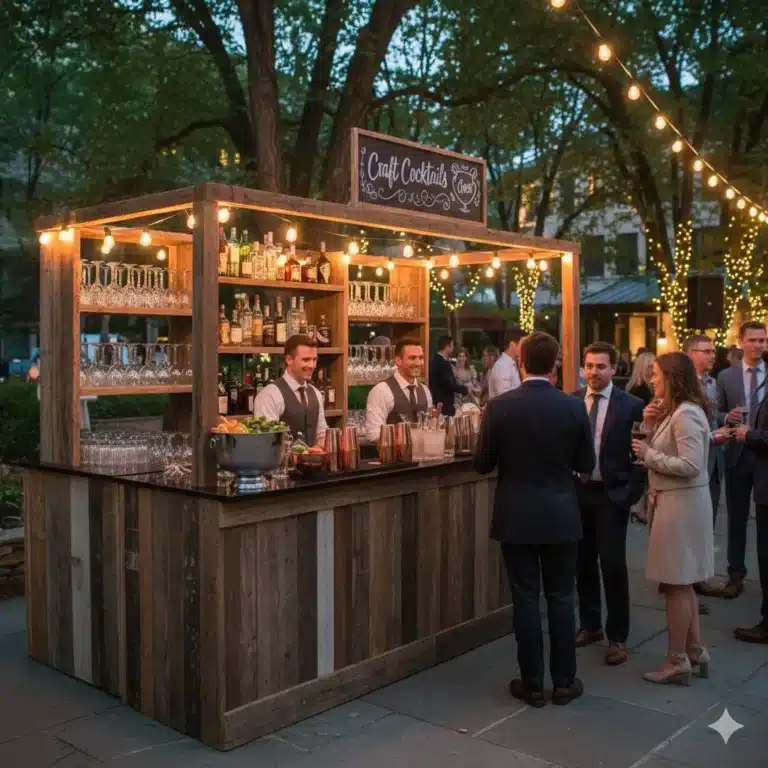
The default for most corporate event planners is a rectangular rental bar, a vinyl wrap, and a banner overhead. It works. It also looks like every other event your guests went to this quarter. A custom-fabricated bar shifts the math — the form factor, the materials, and the silhouette become part of the brand story instead of a backdrop for it.

We’ve built bars from CNC-cut plywood, brushed aluminum, backlit acrylic, and reclaimed barn wood, depending on the brand. A tech client wanted a low-slung concrete-look bar with embedded LED strips and an oversized acrylic logo monolith behind it. A financial services firm wanted the opposite — dark walnut, brass rail, library lamps, the visual language of trust. Both rooms felt unmistakably like the brand within five seconds of walking in.

Three things separate a custom build from a wrapped rental:

  • Form follows brand. Curves, angles, height — these can echo product design, logo geometry, or campaign aesthetics in ways flat graphics can’t.
  • Integrated lighting. Edge-lit logos, backlit shelving, programmable color wash. All of this is baked in during fabrication, not bolted on the day of.
  • Service flow is designed in. Ice well placement, speed rails, garnish trays, register cutouts — built around the actual drink program, not retrofitted.

Throughput Math: How Many Bars Do You Actually Need?

This is the calculation most internal event teams skip, and it’s where cocktail hour falls apart. The rough rule we use:

  • 1 bartender per 75 guests for a full-service bar with mixed drinks, beer, wine, and N/A options
  • 1 bartender per 100-125 guests for a beer/wine/soda-only bar
  • 1 bartender per 150 guests for a single-signature-drink station with pre-batched cocktails

A 300-person event with a 75-minute cocktail window needs four bartender stations at minimum — and you should plan the physical bar so all four can work side-by-side without elbowing. A 16-foot bar handles three stations comfortably. A 24-foot bar handles four to five with room for register access. If the room can’t accommodate that footprint, you need two separate bars in different parts of the room — which also helps disperse the crowd and makes the space feel more activated.

Under-staffing the bar is the single most common mistake we see at corporate events. Guests wait 8 minutes for a drink, miss the kickoff remarks, and the entire program starts behind schedule. The fix is cheap relative to the consequences.

Signature Drink Stations: The Highest-ROI Move at Cocktail Hour

If you only do one thing differently next time, do this: build a dedicated signature drink station next to the main bar. The signature station handles 30-40% of the volume, gets everyone served faster, and creates a single drink — branded, photographed, talked about — that anchors the night.

What makes a signature station work:

  • Pre-batched cocktail. Mixed in advance, poured over fresh ice with a garnish step. Service time per guest: 15-20 seconds, versus 60-90 for a custom order.
  • Visual storytelling. A printed menu card with the drink’s name (tied to your brand or campaign), ingredients, and a quick origin story.
  • Branded glassware or coasters. Whatever the guest holds in the photo carries your logo for the rest of the night.
  • Garnish drama. Smoke, fire (where venues allow), edible flowers, skewered fruit — the moment of build is what gets filmed.

For one product launch we built a hexagonal acrylic station that matched the product’s packaging silhouette, with the signature cocktail named after the product line. Guests queued specifically for that drink. The product team got 200+ user-generated social posts from a 90-minute window — far more than the activation booth across the room produced.

Brand Integration Without Looking Like an Ad

There’s a fine line between branded and over-branded. Guests can spot a logo-stamped, wrapped-everything bar from across the room, and it reads as marketing — which is exactly what you don’t want during the relaxed, networking-driven first hour of an event.

The integration we recommend instead:

  • One hero brand moment. An oversized monogram, logo, or campaign mark integrated into the bar itself — backlit, sculpted, or carved into the face. One bold moment beats five small ones.
  • Material and color choices that echo the brand. If the brand is bold and minimal, the bar should be too. If the brand is warm and craft-driven, lean into wood, brass, and warm light. Guests won’t consciously connect the dots — but they’ll feel it.
  • Branded ephemera. Cocktail napkins, coasters, custom stir sticks, branded ice cubes (clear ice with embedded logos). These are the things that end up in photos and at the bottom of bags days later.

For deeper context on how branded environments translate into engagement, see our rundown of custom event bars and how they shape event design. The same principles scale up to full corporate event production — the bar is often the test case that gets the rest of the room funded.

What Breaks the Cocktail Hour Timeline

Beautiful bars get built. Cocktail hours still go sideways. Here’s where the failures actually happen, in our experience:

Venue load-in windows are too tight

A fabricated bar of any real size is typically 12-24 feet long, modular into 4-6 foot sections, and needs 90-120 minutes for assembly, leveling, plumbing (if there’s running water), and lighting check. If the venue gives you a 3-hour load-in window and the AV team needs 2 of those hours, you’re underwater on the bar before doors open. Build the bar’s load-in into the venue contract, not the production schedule.

Power draw is underestimated

Backlit panels, refrigerated wells, color-changing LED, register, and POS systems on a single bar can pull 20-30 amps. Venues often have one circuit available, and the bar shares it with the catering setup next door. Confirm circuit isolation in writing.

Ice logistics

A 300-person event with cocktails burns through 200-300 pounds of ice in 90 minutes. Most venues can’t make that much on-site. Schedule an ice delivery 30 minutes before doors, and have a designated ice runner staged behind the bar — not your bartender.

The bartender’s view is wrong

If the bartender can’t see the room while making drinks, they slow down. The bar should face into the activity, not against a wall, whenever the floor plan allows it.

Rent, Build, or Buy?

For most corporate teams, the answer is rent a custom-fabricated bar for the specific event — design it for this brand and this room, then return it. The capital efficiency is obvious, and you’re not stuck storing a 20-foot bar between events.

If the brand runs 8+ events a year with consistent visual language, owning makes sense. We’ve built modular branded bar systems that ship flat and reconfigure across activation footprints — 12 feet for a small VIP event, 32 feet for a flagship trade show booth. Browse our custom bar rentals across NYC, CT, MA, and RI to see what we’ve built recently — most of those started as single-event commissions before becoming reusable inventory.

Budget guidance, very roughly:

  • Wrapped rental bar + signage: $1,500-$3,500 for the bar setup
  • Custom-fabricated branded bar, 16 feet: $8,000-$18,000 depending on materials and lighting integration
  • Custom signature drink station + main bar combo: $12,000-$25,000
  • Modular reusable branded bar system: $25,000-$60,000 (one-time build, amortizes across 6-10 events)

Bar service (bartenders, mixers, glassware, ice) is separate and typically runs $30-$50 per guest for a full bar with a signature program.

Cocktail hour is where guests decide whether they're at a meeting or at an experience. The bar settles that question in the first 30 seconds.

Event Fab Team

Serving NY, CT, MA & RI

Our fabrication shop in the New York metro builds custom bars that ship to corporate venues across Manhattan, Brooklyn, Westchester, Fairfield County, Boston, Providence, and the broader Northeast. We handle CAD, fabrication, transport, install, and strike under one team — so the production timeline doesn't fragment across four vendors. For Connecticut, Massachusetts, and Rhode Island clients, we factor regional venue access (BCEC load-in dock, Newport mansion power, Hartford convention floor) directly into the build spec.

Building a Custom Bar for Your Next Corporate Event?

Send us the date, the venue, the guest count, and any brand direction you have. We'll come back with a design concept, a budget range, and a realistic production timeline within two business days.
Request a Quote

Custom Bars for Corporate Events — Frequently Asked Questions

Common questions we get from brand and event teams when they start scoping a custom bar build for a corporate event.

Contact Us

Tell Us About Your Project Or Event
