Industry Insights

Event Industry Trends Reshaping Production in 2026

May 9, 2026 By Event Fab Team 10 min read

The brief usually arrives the same way: “We want something fresh — what are people actually doing this year?” It’s a fair question, but the honest answer for 2026 isn’t a single trend you can drop into a deck. It’s a set of pressures — on budgets, lead times, attention spans, and supply chains — that are reshaping how brand and agency teams build live experiences.

The event industry trends below are the shifts our production team is seeing repeat across briefs from NY, CT, MA, and RI. Each one comes with the execution reality behind it: where the timeline tends to break, where the budget actually goes, and what to ask for in 2026 if you want to land on the right side of the trend instead of chasing it six months late.
Key Takeaways

  • Hybrid is no longer a 2020 holdover — it's a permanent budget line. Expect 25-40% of guest engagement to happen on a screen even at in-person events, and design for it from kickoff.
  • Sustainability has moved from optional to procurement-driven. Brand RFPs in 2026 increasingly require waste diversion plans, reusable scenic, and documented carbon impact from production partners.
  • Experiential brand activations are eating into traditional advertising spend; expect briefs that ask one event to deliver content for paid social, PR, and sales enablement simultaneously.
  • AI and automation are reshaping pre-production — site surveys, render iteration, and rundown drafting are all faster — but the on-site fabrication and labor curve hasn't moved.
  • Lead times for custom fabrication, LED, and rigging are stretching into 6-10 weeks for hero pieces in 2026; book scenic and structural elements before you finalize creative if your show date is fixed.

Why 2026 Doesn't Look Like 2025

Coming out of 2024 and 2025, most production briefs still felt like reactions — to the pandemic, to remote work, to budget cuts, to the sudden return of in-person. 2026 is the first year where most of those reactions have settled into actual operating models. Brand teams aren’t asking whether to do hybrid; they’re asking how to budget for it. They’re not asking whether to care about sustainability; their procurement teams are asking for the documentation.

The result is a market where the trends are less about novelty and more about discipline. The teams winning right now aren’t chasing the most viral activation on TikTok — they’re the ones who have operationalized hybrid delivery, locked in long-lead fabrication partners, and built measurement frameworks that make their event spend defendable to a CFO. That’s the lens to use as you read the trends below.

Trend 1 — Hybrid Becomes a Permanent Production Line Item

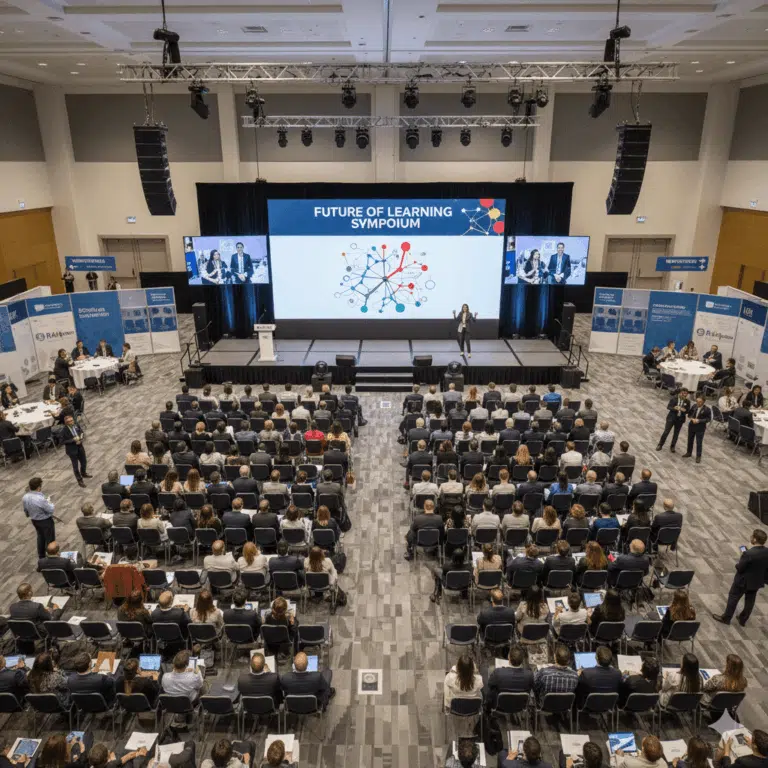
The single biggest shift heading into 2026 is that the live event and the digital event are no longer two different briefs. They’re one production with two audiences, and the production schedule, scenic design, and AV scope all reflect it.

What that looks like in practice:

  • Scenic design built for camera first. Backdrops are sized and lit to look correct on a 16:9 stream before they’re judged in the room. That changes the lighting plot, the gobo placement, and how much negative space the set wall needs.
  • Two-track content schedules. The remote audience gets a tighter rundown with shorter segments and built-in chat moments; the in-person audience gets the networking time the stream can’t deliver.
  • Real broadcast crews, not iPhone streams. Brand teams that tried to cheap out on the digital side in 2024 learned that a 480p Zoom broadcast undercuts the message of a six-figure live event. 2026 budgets reflect that lesson.

If you’re producing a corporate keynote, internal summit, or sponsor activation in 2026 and there’s no line item for digital delivery, the brief is incomplete.

Trend 2 — Sustainability Moves From PR to Procurement

For most of the last decade, sustainability in events meant a press-release sentence about LED lighting and a recycling bin near the bar. In 2026, it’s a procurement requirement. We’re seeing brand RFPs that ask production partners to document waste diversion percentages, name reusable scenic vendors, and provide carbon estimates per guest.

What’s actually changing on the production floor:

  • Modular, reusable scenic builds. Hero pieces like archways, set walls, and branded thresholds are being designed for a second and third deployment. That changes the material spec — aluminum frames, swappable graphic skins, and standardized panel sizes win.
  • Local sourcing inside the Northeast corridor. Trucking a custom build from a warehouse in California to a Manhattan ballroom is harder to defend on a sustainability scorecard than fabricating it in CT or MA. Regional fabrication shops with real production capacity are winning more of these RFPs.
  • Branded reusables instead of single-use. Custom drinkware, signage, and even step-and-repeat printing is being spec’d with second-event reuse in mind, not just trash-out at load-out.

This is one of the trends most directly visible in what we build at our shop. Experiential brand builds are increasingly spec’d with reusable substructures and swappable graphics so the fabrication investment pays back across multiple activations rather than one truck-out to landfill.

Trend 3 — Experiential Eats Into Traditional Ad Spend

One of the clearest patterns we’re seeing in 2026 briefs: a single activation is being asked to do the work of three. The pop-up needs to drive foot traffic. The branded photo moment needs to generate paid-social content. The press preview needs to deliver PR clips. And the sales team needs leads from the same footprint.

That collapsing of marketing channels into a single live experience is the engine behind the rise of modern brand activation services. It’s also why brand activations are pulling spend out of traditional advertising lines — a well-built activation now produces the assets a brand team would otherwise have commissioned from a separate content shoot.

What that means for production scope

Three things change when an activation has to carry three jobs at once:

  1. The hero photo moment becomes non-negotiable, and the lighting plan has to be built around it.
  2. You need a quiet, branded space inside the activation footprint where sales conversations can actually happen — usually a back third of the build with seated furniture and lower volume.
  3. Capture infrastructure — designated photographer/videographer paths, a content runner, a same-day edit deliverable — has to be in the production scope from day one, not bolted on the week before.

If you’re not sure what a brand activation actually is in 2026 versus the looser definitions used five years ago, our breakdown of what a brand activation is, with examples and types walks through the categories that brand teams are actually briefing today.

Trend 4 — AI and Automation Reshape Pre-Production (Not the Build)

This is the trend most often misrepresented in industry decks. AI is not building your stage. It is not running your show. What it is doing — and where the productivity gains in 2026 are real — is compressing the pre-production timeline.

Where we’re seeing AI actually move the needle:

  • Site surveys and CAD intake. Photogrammetry from a site walk-through can now produce a usable rough CAD model in hours, not days, for venues without existing floor plans on file.
  • Render iteration. Mood-board to render cycles that took a week with a 3D artist now happen in an afternoon. That means more creative options earlier, and fewer surprises at the build approval stage.
  • Rundown and run-of-show drafting. First-draft cue sheets and run-of-shows can be auto-generated from a creative deck and a venue spec, saving the production manager half a day per show before any human review.

What hasn’t changed: load-in still takes the same number of trucks. Rigging still takes the same number of crew hours. Custom fabrication still takes weeks of shop time. The labor and materials curve is unmoved. Treat AI as a pre-production accelerator, not a budget reduction lever.

Trend 5 — Lead Times Are Stretching, Not Shrinking

The trend that’s least talked about in industry decks but most likely to break a 2026 production: lead times for the things that matter are getting longer, not shorter.

Where the squeeze is showing up:

  • Custom fabrication. Shops that ran 4-week lead times in 2023 are quoting 6-8 weeks for hero pieces in 2026. Aluminum extrusion, custom millwork, and large-format print are all under pressure.
  • LED and large-format video. Reservation windows for high-resolution LED walls in the Northeast are pushing 8-10 weeks during shoulder seasons (April-June, September-November) when corporate event volume peaks.
  • Rigging crews and IATSE-staffed venues. Skilled riggers are oversubscribed in NYC, Boston, and Hartford metro. Crew calls placed less than three weeks out get backfilled with less experienced labor — which shows up at load-in.

The practical implication: if your show date is fixed, lock fabrication and AV before you finalize creative. The brief that arrives six weeks out asking for a custom 30-foot brand wall isn’t getting built in 2026 — it’s getting rented from existing scenic inventory and re-skinned.

Trend 6 — Smaller Footprints, Higher Production Value Per Square Foot

Average corporate event headcount across our 2026 briefs is down compared to 2023, but average production spend per guest is up. Brand teams are choosing depth over breadth — fewer guests, but a more produced experience for the ones in the room.

That shows up in three concrete ways:

  • More custom scenic per square foot. A 200-person event in 2026 often gets the fabrication budget that a 500-person event got in 2023.
  • Tighter venue selection. Brand teams are passing on cavernous ballrooms in favor of right-sized lofts and converted industrial spaces where the production fills the room.
  • Programmed flow instead of free-roam. Smaller footprints get a defined journey — entrance moment, central activation, photo zone, exit gift — rather than a buffet-and-cocktails sprawl.

You can see this trend at work across the projects in our event showcase — the recent builds are denser and more deliberate per square foot than the pre-2023 work.

What to Ask Your Production Partner Before Signing in 2026

If you’re briefing a 2026 event and you want to land on the right side of these trends, the diligence questions to ask your production partner have shifted. Five worth running through before you sign:

  1. What does your hybrid delivery look like? If the answer is “we’ll bring an iPhone,” keep looking.
  2. What’s reusable in this build? Aluminum substructure, swappable graphics, modular panels — get the percentage of the build that survives to a second deployment.
  3. Where’s your fabrication shop? Northeast-based fabrication shortens trucking, improves carbon math, and makes change orders feasible inside the production window.
  4. What are your current LED and rigging lead times? Honest partners will tell you 6-8 weeks if that’s what the market is doing. Anyone promising 2-week lead times in peak season is either exaggerating or pulling from inferior inventory.
  5. What’s the content capture plan? If your activation needs to deliver paid-social and PR assets, the production partner should have an answer before you ask.

The teams winning in 2026 aren't chasing trends — they're operationalizing them. Hybrid is a budget line, sustainability is a procurement requirement, and lead times are non-negotiable.

Event Fab Team

Serving NY, CT, MA & RI

Our shop and crews are based in the Northeast corridor, which keeps trucking distances short for builds across Manhattan, Brooklyn, Stamford, Hartford, Boston, and Providence. That regional footprint matters more in 2026 than it did three years ago — local fabrication is cheaper to defend on a sustainability scorecard, faster to revise mid-production, and easier to staff with experienced crews who know the city's load-in rules.

Planning a 2026 Event? Let's Pressure-Test Your Brief.

If you're staring at a 2026 brief and trying to figure out where the budget actually goes, send it over. Our team will walk through fabrication scope, lead times, hybrid delivery, and what's realistic in your venue before you commit a vendor. No deck, no pitch — just a production read on what it'll actually take to build.
Request a Quote

Event Industry Trends 2026 — Frequently Asked Questions

The questions brand and agency teams are asking us most often as 2026 production briefs come in:
Contact Us

Tell Us About Your Project Or Event