Large Format Printing

Photo Wall Design: 9 Branded Backdrop Ideas for Modern Events

May 18, 2026 By Event Fab Team 10 min read

The branded photo wall used to be a single decision: how big does the step-and-repeat need to be, and how many logos fit across it? That answer still works for a red-carpet press line — but for product launches, brand activations, and corporate galas in 2026, the photo wall has quietly become one of the highest-leverage creative surfaces of the entire event. It’s where your guests pause, photograph each other, and produce the user-generated content that outlives the room itself.

Below are nine photo wall ideas brand and agency teams are commissioning right now across NYC, Boston, Hartford, and Providence — including the lead times, finish decisions, and venue constraints that separate a backdrop that photographs beautifully from one that photographs flatly. Every concept below is buildable, rentable, or shippable through our shop, and each comes with a realistic production note so you can budget and schedule before you commit.
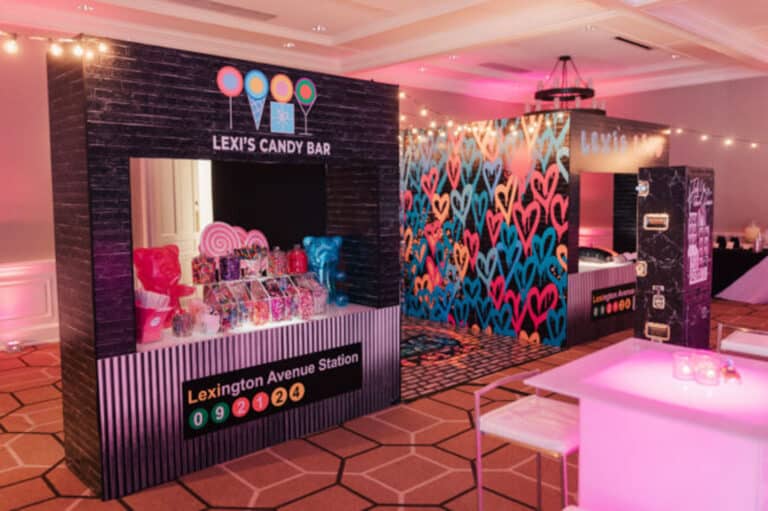
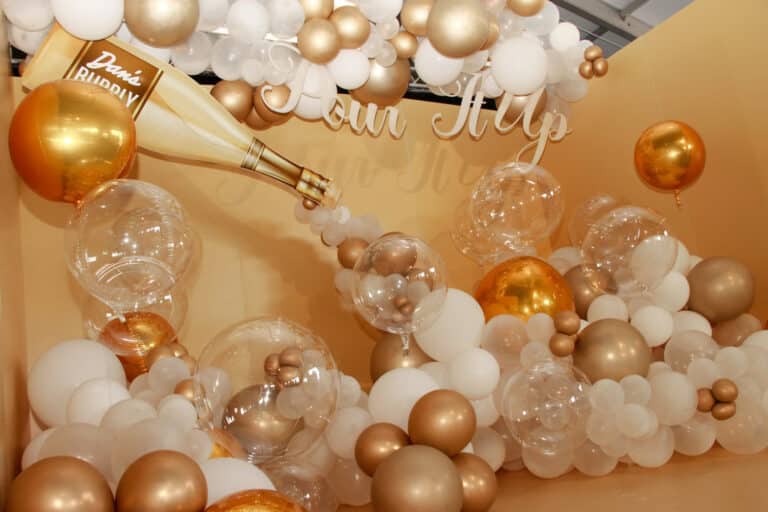
Key Takeaways

  • A modern photo wall is a hero design moment, not a logo decoration — treat it with the same creative discipline as the keynote stage, and the social yield doubles.
  • Dimensional, neon, foliage, mirror, and projection backdrops carry 4 to 6 week lead times once custom fabrication is involved — lock the concept before you lock the venue.
  • Lighting is half the photo wall. A gorgeous build under flat ambient venue light photographs worse than a basic build under intentional accent lighting.
  • The footprint of the photo line — the carpet of guests waiting their turn — is often larger than the wall itself; plan 8 to 12 feet of clear depth in front for queueing and phone framing.
  • Branded backdrops do not have to be one piece — modular systems let you reconfigure the same hardware across multiple events and city stops.

1. Dimensional 3D Photo Walls — Sculpted Logos and Layered Geometry

The fastest way to move beyond a flat printed step-and-repeat is to give the logo and the surrounding pattern physical depth. Dimensional photo walls use CNC-cut foam, layered acrylic, routed plywood, or 3D-printed elements mounted to a flat substrate — and the difference on camera is immediate. A 1.5 inch shadow line behind a hero logo reads on every phone in the room.

Production notes: dimensional builds run 4 to 6 weeks from approved artwork to load-in, because the cut paths, finish samples, and mounting hardware all need their own approval rounds. Budget bands typically land between $4,500 and $18,000 for a 10 by 8 wall, depending on the depth of relief and the finish — matte vinyl on foam is the most economical, hand-painted MDF with metallic leaf is the top end. For multi-city campaigns, the dimensional elements should be engineered as modular branded set pieces so the same logo hardware travels with the tour.

2. Neon and LED Light-Up Backdrops

Custom neon — actually LED neon-flex these days, which is safer, lighter, and bends to tighter radii than glass tube — turns a photo wall into a beacon in dimly lit venues. It works especially well at fashion previews, music industry mixers, and any product launch happening in a converted industrial space in Brooklyn, Long Island City, or the Seaport.

Two configurations that consistently photograph well

  • Neon-on-dark. A matte black or dark velvet backdrop with a single, bright neon hero phrase or logo. High contrast, very forgiving of uneven venue lighting, and prints clean on social.
  • Neon-on-foliage. A preserved moss or faux foliage wall with a contrasting neon line drawing layered on top. Reads as organic on first glance and branded on second.

Production notes: custom neon-flex signage is a 3 to 4 week lead from approved vector art, plus power planning at the venue (most neon walls draw less than a single 15-amp circuit, but you still need to know where it’s running). Color temperature matters — warm white neon on dark velvet consistently outperforms cool white for skin tones in the resulting photos.

3. Foliage and Floral Photo Walls

The biophilic backdrop has gone from a wedding-industry trend to a corporate default. Preserved moss panels, faux boxwood, dried palm, and fresh-cut floral installations are all in regular rotation for brand activations focused on wellness, beauty, sustainability, and lifestyle categories.

Production decisions that matter: preserved versus live versus faux. Preserved moss and dried botanicals are the most durable option, ship everywhere in the Northeast, and survive multi-day activations without water or refrigeration. Fresh floral walls are the most beautiful but require install day-of and have a strict 8 to 10 hour service window before they start to look tired. Faux foliage is the workhorse for touring builds — same wall, five cities, no degradation.

For most brand teams in NYC, CT, MA, and RI, our shop pairs a foliage panel system with a custom-printed branded inset, often a dye-sublimated fabric print panel set into the green field. Lead time runs 3 to 5 weeks once the design is locked.

4. Mirror and Reflective Photo Walls

Mirror backdrops solve two problems at once: they double the visual depth of a small footprint, and they pull guests into the photograph by reflecting the room around them. The two formats that get the most use right now are etched mirror with a brand mark frosted into the surface, and infinity mirror panels with embedded LED for a tunnel effect.

The catch — and it’s a real one — is fingerprints and breath fog. A mirror wall needs a staff touch-up every 20 to 30 minutes during peak photo traffic. Plan for it. We typically recommend a cleaning station tucked behind the wall with microfiber cloths and a non-streak glass spray, and a single greeter who doubles as the touch-up person.

Production notes: framed mirror walls in modular 4 by 8 panels run $3,500 to $9,000 for a typical activation footprint, with 2 to 3 weeks of lead time. Infinity mirror panels with custom LED programming are a 4 to 6 week build.

5. Projection-Mapped Photo Walls

A projection-mapped photo wall replaces the printed graphic with a controllable, programmable surface. The hardware is a white or light-grey physical wall plus a short-throw projector — or two, stitched — driven by media-server software. The content can rotate every 60 seconds, react to a guest stepping into frame, or cycle through partner logos across an evening of sponsored moments.

This is the right call when the same photo wall needs to serve multiple creative messages in one event — for example, a press hour, a VIP hour, and a main party with three different brand stories. It’s also the right call for venues with ceiling and rigging limits that make giant printed surfaces logistically painful.

Production notes: budget $7,500 to $25,000 for a single-wall projection setup including hardware, content programming, and an on-site technician. Lead time is 4 to 8 weeks because content creation runs in parallel with physical build. Venue ambient light is the biggest variable — projection in a bright daytime lobby will lose contrast, so the wall needs flanking blackout drape or a controlled lighting zone.

6. Branded LED Video Wall Backdrops

An LED video wall used as a photo backdrop is the maximum-effort, maximum-impact version of the same idea — and unlike projection, it works in any ambient light condition. A 10 by 6 LED wall in a brightly lit ballroom still photographs sharp and saturated because the surface is emissive, not reflective.

LED walls are the right choice when the photo backdrop also needs to serve as live broadcast graphics, sponsor rotation, or interactive content. They are the wrong choice for a single static logo at a 50-person dinner — that’s a step-and-repeat job, not a six-figure LED build.

Production notes: LED video panel rental runs by square footage and pixel pitch. For close-up photo framing, 2.6mm pitch or finer is the standard; coarser pitches will show the dot pattern in phone photos taken from 4 to 6 feet away. Lead time on inventory is 2 to 3 weeks for our regional fleet, longer for custom curved configurations.

7. Fabric and Soft-Goods Backdrops

The quiet workhorse of modern event backdrops is large-format printed fabric — dye-sublimated polyester stretched over an aluminum frame, or pole-pocket fabric hung from a pipe-and-drape system. Soft goods solve a list of practical problems that rigid backdrops can’t: they ship flat, pack into a case the size of a roller bag, never crease the way vinyl does, and can be swapped between events in 15 minutes.

This is the format that scales for touring activations. A single set of frames and pipe with three or four printed fabric panels turns one rental into four distinct looks. For multi-city brand campaigns across the Northeast, our shop builds these as a touring kit and the production team ships them city-to-city in a single Pelican-style crate.

Production notes: dye-sub fabric production is 5 to 10 business days for stock dimensions, longer for oversized seamless panels (anything over 10 feet tall requires seam planning). Frame rental is in stock in our NY warehouse and can be configured for almost any footprint between 4 by 6 and 20 by 12.

8. Modular Step-and-Repeat — Done Properly

The traditional step-and-repeat isn’t dead. It’s still the right tool for press lines, red carpets, sponsor activations, and any moment where the objective is clean logo legibility in published photos. What’s changed is the production craft — the bad step-and-repeats now look bad because the good ones got noticeably better.

What separates a premium step-and-repeat from a cheap one

  • Print substrate. Matte-finish dye-sub fabric photographs without glare; glossy vinyl reflects every overhead can light and creates hotspots in the resulting images.
  • Logo spacing. Tight enough to ensure at least two full logos appear in any tightly cropped portrait, loose enough to breathe.
  • Frame engineering. A flat, unwrinkled, properly tensioned fabric face — not a vinyl that has been folded in a box for six weeks.
  • Hidden hardware. No visible pipe bases or sandbags in the shot.

We covered the full production playbook for this format in our guide to branded step-and-repeat printing — worth a read if a press-line backdrop is part of your event timeline.

9. Hybrid and Custom Sculptural Backdrops

The most memorable photo walls of the last two years have been hybrids — neon plus foliage, dimensional plus projection, LED inset into a sculpted framework. The best brand activations don’t pick one of the categories above; they combine two or three into a one-of-a-kind environment that doubles as a press moment and a Instagram-driver.

A sculpted hybrid wall is custom by definition. It starts from a brief, moves to renderings, gets engineered for safe install, and gets built — and that process takes 8 to 12 weeks. The cost band runs from $12,000 for a moderately sized hybrid up to $75,000+ for hero installations at flagship product launches or fashion week activations.

When brand teams come to us with a sculptural hybrid concept, the project is usually run through our full event backdrop production service, which covers design, fabrication, install, on-site touch-up, and strike under one production owner.

The photo wall is no longer the polite logo-decoration at the corner of the room. For a modern activation, it's the single piece of scenic that has to do the most public-facing brand work — and it deserves the same creative discipline as the keynote stage.

Event Fab Team

Photo Wall Production Across NY, CT, MA & RI

Our shop builds and installs branded photo walls across Manhattan, Brooklyn, Long Island City, Hartford, Stamford, Boston, Cambridge, and Providence — covering most major venues, hotel ballrooms, museums, and industrial event spaces across the Northeast. Same-week consultations are typical; full custom fabrication runs the 4 to 12 week lead time bands described in each section above.

Ready to design a photo wall your guests will actually photograph?

Send us your event date, venue, and creative direction — even a rough one — and our production team will come back with a buildable concept, a realistic lead-time map, and a budget band so you know exactly what's possible inside your window.
Request a Quote

Photo Wall Design — Frequently Asked Questions

The questions brand and agency teams ask us most often when they're scoping a branded backdrop for an activation, launch, or corporate gala.

For a single-person portrait crop, 8 feet wide by 8 feet tall is the minimum. For pairs and small groups, plan 10 by 8. For full press lines where three or four people will stand together, go to 16 by 8 or wider. Height of 8 feet is a strong floor — shorter walls force photographers to crop above the wall and your branding falls out of the shot.

For standard step-and-repeat or fabric backdrops, 2 to 3 weeks is workable. For dimensional, neon, foliage, mirror, or projection builds, plan 4 to 8 weeks from approved creative. Hybrid sculptural installations run 8 to 12 weeks. The single most common timeline failure is locking the concept too late, then squeezing production into a window that doesn’t exist.

Almost always, yes. Venue ambient lighting is rarely flattering for phone-camera portraits and frequently casts hard overhead shadows on guest faces. Two soft accent fixtures angled 45 degrees onto the wall, plus a fill light at face height, transforms the photo quality. For neon and projection walls, you specifically want the surrounding ambient pulled down so the wall is the brightest object in frame.

Yes — if you engineer it for that from the start. Modular framing, swappable printed panels, and crated transport turn a one-time wall into a touring asset. Dimensional and sculptural elements need to be specifically built for repeated load-in cycles; off-the-shelf foam decor will not survive three flights and four warehouse moves.

Yes for hashtags — typeset cleanly into the design, not slapped on as an afterthought. Cautiously yes for QR codes — they work, but they should be sized large enough to scan from 6 feet away (typically 6 by 6 inches minimum) and placed at hip-to-shoulder height where guests can actually see them without breaking the photo composition.

Step-and-repeat with quality fabric print and clean framing: $1,500 to $4,500. Dimensional or foliage backdrop: $4,500 to $18,000. Neon, mirror, or modular hybrid: $7,500 to $25,000. LED video wall or projection-mapped build: $10,000 to $40,000+. Sculptural hero installations at flagship product launches: $25,000 to $75,000 and up.

Contact Us

Tell Us About Your Project Or Event

Which of our services are you interested in?*
Preferred Contact Method*
