Industry Insights

The Conference Room of the Future: Event Tech Trends to Watch

June 25, 2026 By Event Fab Team 9 min read

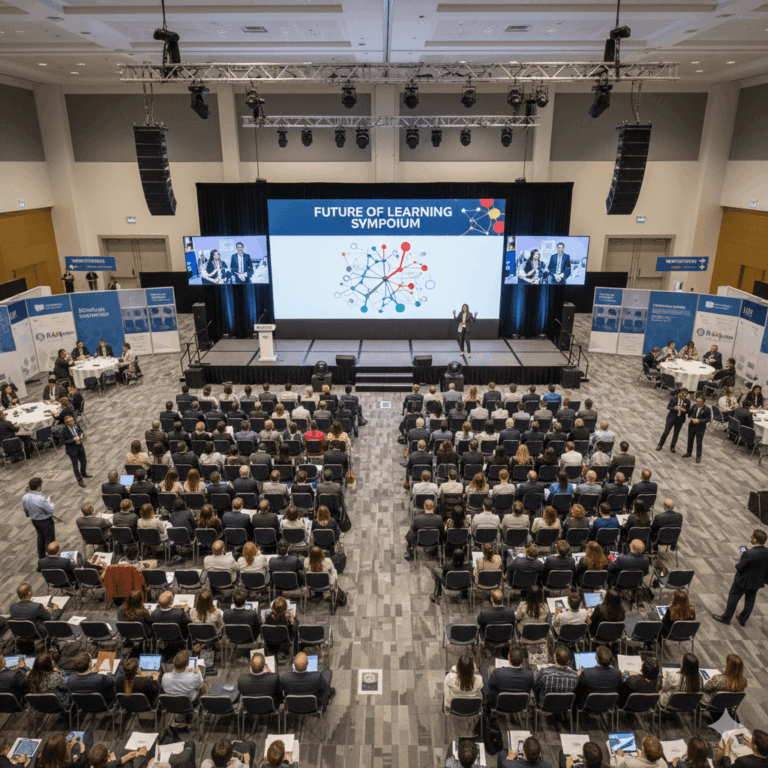
The phrase “conference room of the future” used to mean a nicer projector and a better speakerphone. That era is over. The room itself has become a production environment — a space where live video, real-time content, and audience interaction all have to work together on a schedule, in front of people, with no second take.

For brand and agency teams planning corporate events across the Northeast, the interesting event technology trends are not the gadgets. They are the production decisions behind them: what to build, what to rent, what bandwidth you actually need, and how much lead time each choice quietly demands. This is a look at the trends worth planning around in the next 12 to 18 months — and what each one costs you in time and budget before the doors open.

Key Takeaways

  • Hybrid streaming is now a baseline expectation, not an upgrade — budget for a dedicated AV and streaming line from day one, not as a late add-on.
  • Smart stages built on LED replace static scenic; they cut load-in time but push more work upstream into content production, often 3-5 weeks before show day.
  • AR and mixed-reality activations read well on camera and on socials, but they need rehearsal time and a fallback plan — treat them as a feature, not the whole show.
  • Interactive displays drive measurable engagement, but only if the content and data capture are designed in early, not bolted on the week of.
  • Venue bandwidth and power are the silent failure points — confirm both in writing during your site visit, especially in older NYC and New England buildings.

The room is now a broadcast set

The single biggest shift is that nearly every meaningful corporate event is filmed, streamed, or both. That changes the room from a place where people sit to a set that has to look right on a 1080p feed and a phone screen at the same time. Lighting that was fine for a live audience can wash out on camera. A backdrop that reads clean in person can moire or go muddy on a stream.

Practically, this means the AV backbone is no longer a line item you finalize last. Camera positions, audio capture, lighting, and the streaming encode all have to be planned together. The teams that handle this well treat it as a single system — which is why professional AV services and content production are increasingly scoped as one conversation rather than two vendors who meet for the first time at load-in.

What this changes in your timeline

  • Lock your camera and stream plan at least 4 weeks out, not the week of.
  • Budget a dedicated technician for the stream — someone whose only job is the feed.
  • Plan a full technical rehearsal with the actual encode, not just a mic check.

Hybrid streaming becomes the default

Hybrid is no longer the pandemic-era compromise. For product launches, internal town halls, and partner summits, a remote audience is now assumed — and that audience often outnumbers the people in the room. The trend worth planning around is not whether you stream, but how seriously you treat the remote experience as its own production.

The common failure is treating the stream as a webcam pointed at the stage. The remote audience needs cut camera angles, readable on-screen graphics, audio mixed for headphones, and a host who acknowledges they exist. That requires a switcher, a comms plan, and redundancy on the internet connection — a primary hardline plus a bonded cellular backup is now standard practice for anything you cannot afford to drop.

Budget bands are wide, but a credible hybrid setup for a mid-size corporate event in the region typically runs from the low five figures for a clean single-camera stream up to well into the five figures for multi-camera with branded graphics and redundancy. The deciding factor is usually how many cameras and how much custom on-screen content you want, not the room itself.

Smart stages: LED replaces scenic

The most visible trend on the show floor is the move from printed or built scenic to LED-driven “smart stages.” Instead of a fabricated backdrop that does one thing, the stage becomes a programmable surface — it can be a keynote backdrop, a product hero shot, a live data dashboard, and a sponsor reel across a single event.

The upside is real: faster load-in than heavy scenic, infinite content flexibility, and a look that photographs beautifully. The catch is that the work moves upstream. A blank LED wall is just an expensive gray rectangle until someone produces content for it, sized to the exact pixel pitch and resolution of the panels. That content production is where timelines quietly stretch — plan 3 to 5 weeks for motion content done well.

If you are weighing LED for a stage or environment, our custom LED video wall rentals cover the build side, and our deeper primer on LED video wall rentals walks through pixel pitch, sizing, and the questions to ask before you commit. The short version: decide your content plan and your wall resolution at the same time, because one dictates the other.

AR, VR and mixed reality — where they actually earn their keep

Augmented and virtual reality get the headlines, and they can be genuinely effective — but the production reality is more disciplined than the demo videos suggest. The activations that work tend to share three traits: they have a clear single purpose, they are short enough to keep a line moving, and they have a low-tech fallback if a headset dies or a tracking marker fails.

Where mixed reality earns its keep right now:

  • On-camera AR graphics — virtual elements composited into the live stream, so the remote audience sees product callouts or data that the in-room audience does not. High impact, controllable, no headsets to manage.
  • Product visualization — letting attendees see a configurable or oversized product at scale when you cannot ship the real thing. Strong for B2B and industrial brands.
  • Wayfinding and gamified booths — light AR layers that guide foot traffic or reward exploration at large trade shows.

The honest caution: full VR experiences with managed headsets are staffing-heavy and slow throughput. They suit a flagship moment, not a whole floor. Rehearsal time is non-negotiable — build at least one extra tech rehearsal into the schedule for anything with real-time tracking.

Interactive displays and audience participation

The quieter, more reliable trend is interactive content: touchscreens, motion-triggered walls, live polling, and second-screen experiences that turn a passive audience into a participating one. These tend to deliver better measured engagement than flashier formats because they are easier to use and capture data cleanly.

The discipline here is designing the interaction and the data capture early. A touch wall that just loops a brand video is a missed opportunity; one that lets attendees configure a product, enter a contest, or leave a response gives the marketing team something to take home. Our work on interactive displays and installations across NY, CT, MA and RI consistently shows the same thing: the engagement numbers track with how early the content and the capture flow were designed, not with how big the screen was.

Practical guidance: decide what data you want to collect before you design the interaction, make the first touch obvious within two seconds, and pressure-test the experience with people who have never seen it.

The planning realities nobody puts on the rendering

Every trend above shares the same hidden dependencies: power, bandwidth, and lead time. These are the things that break a timeline, and they rarely show up in the pretty rendering.

  • Bandwidth. Streaming, interactive displays, and live data all compete for the same pipe. Confirm the venue’s dedicated bandwidth in writing during the site visit — house WiFi is not a streaming plan, especially in older buildings around Manhattan, Boston, and Providence.
  • Power and distribution. LED walls and large displays draw real current. Older venues in the Northeast often need supplemental distribution, which has its own lead time and permit considerations.
  • Content lead time. The hardware can often be turned around quickly. The content for it cannot. Motion graphics for LED, AR assets, and interactive flows are where the calendar gets tight — start them the moment the creative is approved.
  • Rehearsal. Every layer of technology adds a point of failure. Build the schedule so there is time to run the whole show, including the stream, before an audience ever sees it.

None of this is a reason to avoid new technology. It is a reason to scope it honestly. The events that feel effortless are the ones where the team planned around these realities instead of discovering them at load-in.

New event technology rarely fails because the gear is bad. It fails because the content and the bandwidth were an afterthought. Plan those first and the room takes care of itself.

Event Fab Team

Serving NY, CT, MA & RI

We build and run event technology for brand and agency teams across New York, Connecticut, Massachusetts and Rhode Island — from corporate stages in Manhattan to product launches in Boston and partner summits in Providence and Hartford. We know which venues have the power and bandwidth to support smart stages and hybrid streaming, and where you will need supplemental distribution, so the technology plan fits the building from day one.

Planning an event that needs to look as good on camera as in the room?

Tell us what you are building and when. We will help you scope the AV, LED, streaming, and interactive pieces with realistic lead times and budget bands — before anything gets locked.
Request a Quote

Event Technology Trends — Frequently Asked Questions

The questions brand and agency teams ask most often when they are scoping technology for a corporate event in the Northeast.
Contact Us

Tell Us About Your Project Or Event