Large Format Printing

Custom Backdrops vs Step-and-Repeats: Which One Should You Use?

May 29, 2026 By Event Fab Team 9 min read

Two words come up in every brand activation kickoff: backdrop and step-and-repeat. They get used interchangeably, billed against the same line item, and approved without anyone confirming which one the photographer actually needs. That confusion is what blows up the on-site moment when guests start posting and the logo crops out of every frame.

This guide breaks down when each format wins, what they cost in real production budgets, and how they perform in the photo and on social. If you are scoping a press wall, a brand lounge, or a stage moment for an event in NY, CT, MA, or RI, read this before you finalize the floor plan.
Key Takeaways

  • A step-and-repeat is a tiled logo wall built for press and photo lines — its only job is brand visibility in tight crops.
  • A custom backdrop is a designed environment — scenic, dimensional, or fabric — built for the experience, not just the camera.
  • Step-and-repeats start around $600–$1,500 printed; custom scenic backdrops typically run $2,500–$15,000+ depending on build complexity.
  • Lead time matters: print-only step-and-repeats need 5–10 business days; fabricated backdrops need 3–6 weeks plus shop time.
  • Photo performance is about logo density, lighting angle, and stand-off distance — not just the print itself.

Step-and-repeat: the press-line workhorse

A step-and-repeat is the tiled logo wall behind a red carpet, a press check-in, or any moment where guests pose and a photographer fires from six to twelve feet away. The format exists for one reason: when the camera crops tight on a face, at least one logo should still appear in frame. That is why the logos repeat in a staggered grid — it guarantees the brand mark survives any crop.

Step-and-repeats are usually printed on tensioned fabric or vinyl, mounted to a pipe-and-base frame, and broken down in under twenty minutes. They travel flat, they fit through any service elevator, and they are the most cost-efficient way to put a brand on every photo that leaves your event.

Where they work best:

  • Press arrivals and red carpets — talent walks, photographers shoot, logo lands in every shot.
  • Award show winners walls — quick rotating photo line behind the stage.
  • Conference check-in moments — sponsor logos visible without dominating the lobby.
  • Influencer photo lines at product launches — predictable backdrop for content creators.

We cover format mechanics, anchor text, and finish options in more depth in our guide to branded step-and-repeat printing — worth a read if you are repeatedly buying the same wall and want to standardize the template.

Custom backdrops: when the room itself is the brand

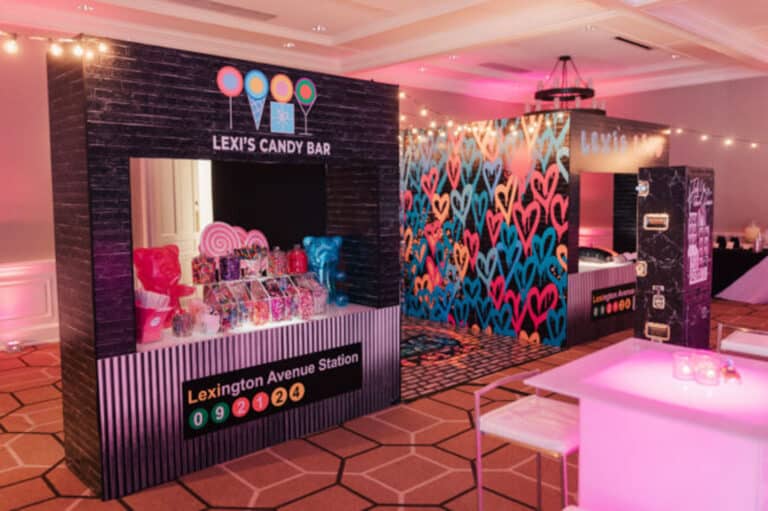
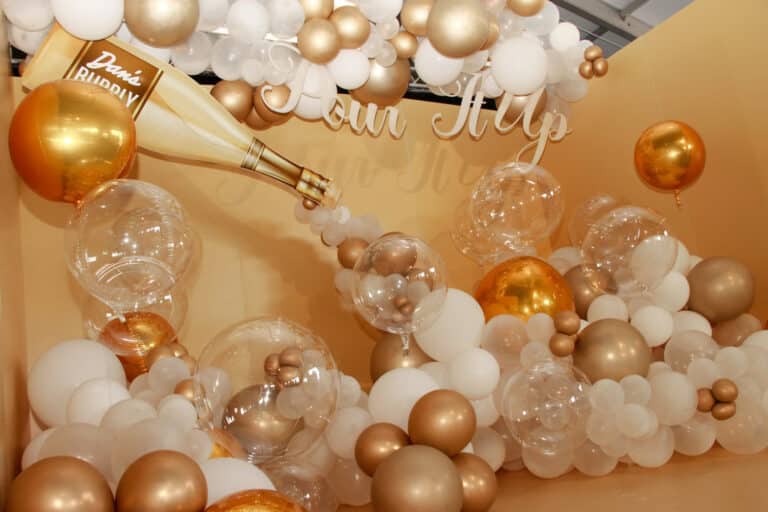
A custom backdrop is the answer when the activation is more than a press line. Think dimensional sets, fabric tension structures, scenic flats with practical neon, illuminated brand sculptures, photo moments built around a product hero. The brief is no longer ‘put logos behind the guests’ — it is ‘build a space the guest wants to stand inside of and share.’

Custom backdrops live across several disciplines. Some are rentable backdrop systems that we re-skin for each client — modular wall units, curved fabric tension frames, hex grids, draped silk. Others are full branded stage elements and set pieces built from CNC-cut MDF, welded aluminum, or 3D-printed components and finished in the shop before they touch the venue.

The decision tree usually comes down to three questions:

  • What is the dwell time? If guests are pausing, exploring, or interacting, you need a backdrop with depth — not a flat logo wall.
  • Is this a hero moment for social? Pinterest-saved, Instagram-grid-worthy moments need lighting, dimension, and a clear focal point.
  • Will the asset get reused? Brands running multi-city tours often spec modular custom backdrops they can pack, ship, and rebuild.

Custom backdrops are where the brand story becomes a physical place. They are also where production complexity, lead time, and budget climb fast — which is exactly why the choice matters.

The cost conversation — what each format actually budgets at

Real production budgets, not vendor sticker prices. These ranges reflect what brand teams pay end-to-end in the Northeast market — print, frame, install, strike, and tax included where applicable.

Step-and-repeat: $600–$1,500

A standard 8′ x 8′ tensioned fabric step-and-repeat with pipe-and-base hardware, single-day rental, install and strike inside a Manhattan venue, lands in the $1,100–$1,500 band. Print-only — meaning you already own the frame — can drop to $400–$700. Going wider (16′ x 8′ for talent walls) pushes you toward $1,800–$2,400.

Custom backdrop: $2,500–$15,000+

A simple custom-scaled fabric wall with applied vinyl and uplight runs $2,500–$4,500. A dimensional scenic moment — push-through letters, layered logos, integrated neon, foliage — sits in the $6,000–$12,000 zone. Larger scenic environments with multiple wall planes, ceiling treatments, or motion components routinely cross $15,000–$40,000 once you add structural engineering, scenic paint, and the rigging package.

One nuance worth budgeting for: custom banners and fabric prints are often used as the brand layer on a structural frame the client already owns. That is the cheapest path to a custom-feeling backdrop — fabric you re-skin per event, frame you keep in the warehouse.

Lead times — the part nobody plans for

Cost gets attention. Lead time is what actually breaks the timeline.

  • Step-and-repeat (print + standard frame): 5–10 business days from final artwork approval to delivery. Rush turnarounds of 48–72 hours are possible in NYC and Boston but carry 30–50% premiums.
  • Custom fabric backdrop (re-skin of existing structure): 2–3 weeks. The print itself is fast; sample approval and color-matching against brand guidelines eats the schedule.
  • Dimensional custom backdrop: 3–6 weeks for design, engineering, fabrication, and finishing — and that is once the brief is locked. Major scenic builds need 8–12 weeks minimum.

Permit windows matter too. A backdrop higher than 8′ tall in some NYC venues triggers an engineering signoff. Outdoor activations in Connecticut and Massachusetts often require ground-anchoring spec and a windload calculation. Rhode Island waterfront venues — Newport in particular — have local fire marshal review on any scenic over 96 square feet. None of that is impossible; all of it adds two to four weeks if you have not started early.

Photo performance: what actually shows up on Instagram

The reason brand teams pick the wrong format is almost always the same: they planned for the room, not the camera. A backdrop only matters if it photographs well, and photo performance is governed by four things you can spec before art goes to print.

  • Logo density. Step-and-repeats need logos sized so two-to-three fit in a vertical phone crop from 8′ away. Logos that are too large get cut in half; too small disappear.
  • Logo contrast. White-on-color and color-on-white print well. Tone-on-tone (charcoal on black, cream on white) photographs flat under venue lighting and reads weak on social.
  • Stand-off distance. Press lines need 6–10 feet between the talent and the wall to keep faces in focus and avoid shadow lines.
  • Lighting angle. Front-cross light kills hotspots on fabric and vinyl. Direct downlight blows out the top of the wall and shadows the bottom. The brief should always specify lighting position — most photographers will tell you the venue’s house lights are not enough.

Custom backdrops change the math entirely. The KPI shifts from ‘logo in frame’ to ‘frame worth posting.’ That is why dimensional sets, illuminated environments, and immersive activations consistently outperform flat step-and-repeats on user-generated content — guests want to be inside the moment, not in front of a wall.

How to choose — a quick decision framework

Use this if you have ten minutes before the kickoff call.

  1. Is there a press line or photo call? If yes, you need a step-and-repeat — even if you also build a custom moment elsewhere.
  2. Is the brand asking for a ‘shareable moment’? That language always means a custom backdrop. A step-and-repeat will disappoint the brand team within thirty days of the post-event recap.
  3. What is the lead time you have left? Under three weeks, you are limited to a print job on existing hardware. Three to six weeks opens up modular custom builds. Eight-plus weeks unlocks anything.
  4. What is the reuse plan? Single-use? Step-and-repeat or printed fabric. Recurring event series, tour, or multi-city activation? Spec the structural backdrop once and re-skin the fabric per stop.

One last note: there is no rule that says you have to pick one. The most-photographed brand activations we produce in the Northeast almost always include both — a step-and-repeat at arrivals for clean press capture, plus a custom backdrop or scenic moment inside for the social-driving content. Different jobs, different cameras, different KPIs.

A step-and-repeat protects the press shot. A custom backdrop earns the post. The brands that get talked about budget for both.

Event Fab Team

Serving NY, CT, MA & RI

We fabricate, install, and strike backdrops and step-and-repeats across the Northeast — Manhattan, Brooklyn, and Queens venues, Hartford and New Haven activations, Boston Seaport launches, and Newport waterfront events. Our shop builds in Connecticut and trucks to site, which keeps install windows tight and protects scenic finishes from the freight handling that out-of-region vendors can't avoid.

Need a backdrop spec'd before your next activation?

Send us the brief — venue, date, guest count, and what the brand wants the photo to look like. We'll come back with a recommendation on format, a real lead-time estimate, and a budget band you can take into the client conversation.
Request a Quote

Custom Backdrops vs Step-and-Repeats — Frequently Asked Questions

Real questions from brand and agency teams scoping backdrops for activations across NYC, Connecticut, Massachusetts, and Rhode Island.
Contact Us

Tell Us About Your Project Or Event
