Event Fabrication

Custom Stage Design: How to Build a Memorable Event Centerpiece

May 6, 2026 By Event Fab Team 9 min read

The stage is the thing your guests photograph. It is what shows up in the post-event recap, the keynote livestream, the sponsor deck, and every Instagram story leaving the room. A great custom stage design carries the brand the way a logo never can — at scale, with depth, lit, and framed by humans. A weak one quietly tells the audience the rest of the production is going to feel rented.

This is the playbook brand and agency teams use when they want a stage that earns its real estate: anatomy, materials, scale, brand integration, and the production realities — lead time, permits, load-in — that quietly decide whether the build that looked great in renders survives a Wednesday afternoon in a Manhattan loading dock.

Key Takeaways

  • A well-designed stage has four core layers: deck, structure, fascia, and set pieces — each one solves a different problem.
  • Size the stage to sightlines and camera framing first, audience count second; an oversized stage swallows energy in the room.
  • Plan a 6–10 week lead time for fully custom builds; printed graphics and standard modular decks can move faster.
  • Brand integration works best when the logo is one element of a scene, not a sticker on a black box.
  • NYC, Boston, and CT venues each have their own load-in quirks — confirm freight elevator dimensions, union rules, and curfews before you finalize the design.

The Anatomy of a Custom Stage

Before you talk about stage design as a creative idea, it helps to know what you are actually building. Most event stages are made of four layers stacked in front of an audience.

  • Deck. The platform itself. Standard event decks are 4’×8′ modules, typically 16″, 24″, or 32″ tall. Custom builds use plywood-skinned framed sections in whatever footprint the program requires. The deck dictates how performers, presenters, and crew move during the show.
  • Substructure. The frame under the deck. Steel and aluminum truss for heavier rigs and large spans, hardwood framing for shorter, sculpted pieces. This is what determines load capacity, sound (a hollow stage drums under heels), and how flat the surface stays after eight hours of foot traffic.
  • Fascia and skirting. The vertical face the audience actually sees. A blackout drape is the cheapest version. A printed wrap, raked panel, LED tile, or sculpted facing turns the stage edge into a brand surface.
  • Set pieces. Everything that lives on or behind the deck — backwall, header, side towers, custom furniture, lecterns, logo monoliths. This is where most of the visual identity ends up.

Designing in those four layers separately keeps the conversation honest. “Make it look bigger” is not actionable. “Add a 12-foot header above the deck and rake the fascia in brand color” is.

Sizing the Stage to the Room

The most common mistake on a custom stage build is making it too big. A stage that swallows the room kills intimacy, exposes empty deck on camera, and forces presenters to walk distances they did not rehearse. A stage that is too small puts speakers in front of a backdrop that does not frame them.

Use this order of operations:

  1. Sightlines first. Every seat in the back row needs to clearly see the speaker’s face above the heads of the audience in front. For a flat-floor room, that usually means a 24″–32″ deck for an audience under 200 and 32″–48″ for larger rooms. Banked or theater seating may need less height.
  2. Camera framing second. If the show is being shot or streamed, the camera operator needs a usable medium shot — speaker plus branded backdrop — and a wide that includes set pieces. That shot list determines backdrop width.
  3. Performance footprint third. Single keynote at a podium needs a 12’×8′ deck. A panel of four with chairs and a coffee table needs 20’×12′. A band with monitors and a drum riser starts at 24’×16′ and grows. Add a comfortable 3′ runoff on each side for entrances.
  4. Audience count fourth. The room capacity is a constraint, not the design driver. A 600-person ballroom does not automatically need a 40-foot stage.

The rendered drawing should always include audience eye lines from the front and back rows. If the rendering only shows a hero camera angle, you are buying a photoshoot, not a stage.

Materials, Finishes, and What Reads on Camera

The material spec is where custom stage design earns or loses its budget. A few rules of thumb from the shop floor:

  • Plywood and MDF are the workhorses of event fabrication. They paint cleanly, route into curves, and tour reasonably well. Use them for any sculpted facing, set piece, or branded monolith.
  • Painted finishes need to be sealed and matte for video. Glossy paint catches the wash lights and creates hot spots on camera. Plan a full color match with a real Pantone chip — never a screen reference.
  • Printed wraps on dibond or sintra are the fastest way to put high-resolution brand art on a vertical surface. They print in 48-hour windows and survive transport better than stretched fabric.
  • LED tile reads brilliantly in person and terribly on camera unless the shutter is genlocked to the panel refresh rate. If you are streaming, talk to the video engineer before you spec a tiled backwall.
  • Acrylic and aluminum are useful for logo and sign work — laser-cut, edge-lit, or stand-off mounted. They look expensive when lit correctly and cheap when lit flat.

Mixed-material stages — a wood-skinned deck with a printed fascia, a sculpted side tower, and an LED header — almost always outperform single-surface builds in photos and on camera. Each material catches light differently, and the variance is what creates depth.

Brand Integration That Doesn't Look Like a Logo Sticker

The fastest way to make a stage look generic is to slap a logo on a black box and call it branded. The fastest way to make a stage feel like a brand world is to treat the build as a scene the audience is stepping into.

Three patterns we use on branded stage elements and set pieces across NYC, CT, MA, and RI events:

  • Make the wordmark architecture. A 14-foot stand-off logo cut from CNC’d MDF, mounted three feet off the backwall with a downlight grazing the side, will read as part of the set — not as a graphic. Same logo printed flat on dibond reads as a sign.
  • Use color to control where the eye goes. If the brand palette is two colors plus black, paint the deck and fascia in neutral and reserve the brand color for one focal element — a monolith, a header, a gobo, a chair. The color punch is what people remember.
  • Layer textures the brand owns. If the brand uses ribbed glass in retail, build a ribbed acrylic side tower. If it uses oak in print, skin the deck fascia in oak veneer. The stage becomes an extension of the brand’s physical world rather than a translation of its digital one.

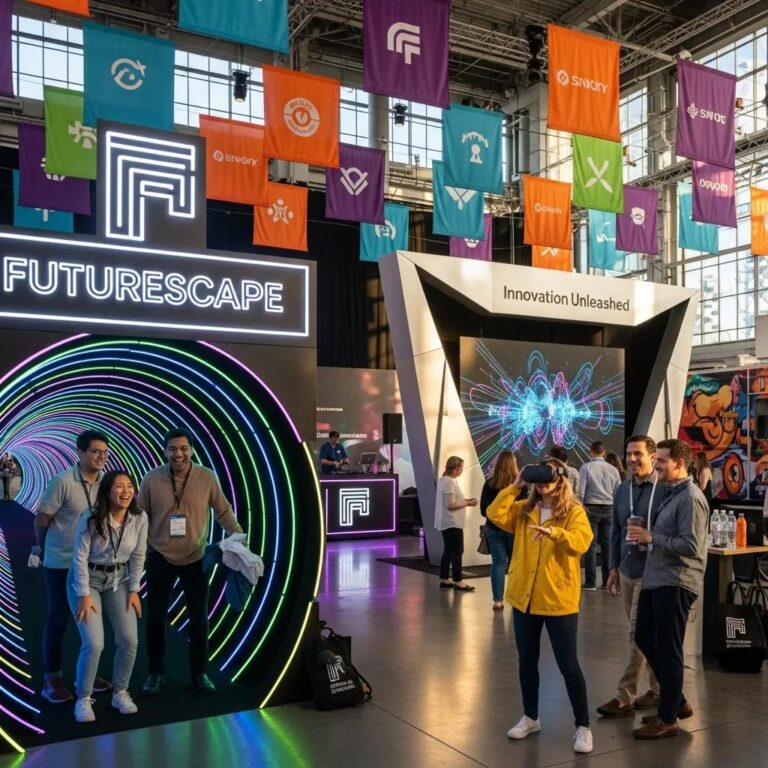
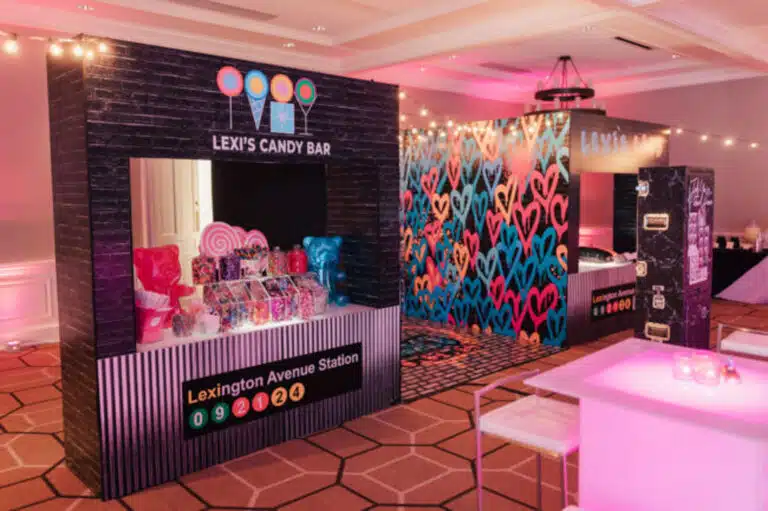
For inspiration, our event showcase has examples of stages where the brand is felt in the architecture, not just the graphics.

Production Realities: Lead Time, Permits, and Load-In

This is the section most decks skip and most timelines suffer from. The build is half the project. Getting it into the room is the other half.

Lead time

For a fully custom stage with sculpted set pieces, plan 6–10 weeks from final design approval to load-in. Modular decks with printed wraps can move in 2–3 weeks. Anything involving sourced materials — specialty veneers, custom acrylic colors, oversize LED — adds 1–2 weeks. Rush builds are possible but compress QA and add cost.

Permits and venue approvals

For builds over a certain height or load — typically anything with rigging into the venue’s grid, or any build over 10 feet tall — NYC venues require an engineering stamp on the structural drawings. Some Manhattan venues also require flame certificates on every soft good. Boston’s larger venues and Convention Center spaces have their own union load-in rules. Build a permit window of 2–4 weeks into the calendar — confirming this two days before the truck rolls is how shows get cancelled.

Load-in and the freight elevator math

This is where boutique NYC venues quietly punish ambitious designs. A 16-foot header looks great in renders but does not fit in a 7’×7’×9′ freight elevator at a SoHo loft venue. Before you finalize a single set piece, get the freight elevator dimensions, the loading dock height, and the door clearance from the venue. Sectional builds — designed to break down into transport-friendly modules and reassemble cleanly on site — are not a compromise. They are the difference between a 9 PM strike and a 2 AM one.

Working With a Fabrication Partner

The cleanest stage builds happen when the design team and the shop are in the same conversation early. Hand a finished render to a fabricator three weeks before load-in and you will get back a list of compromises. Loop the shop in at concept and you get back engineering, smarter materials, and a build that actually matches the renders.

What to bring to that first conversation:

  • The venue address and a CAD or floor plan of the room.
  • Audience count, seating layout, and camera plan.
  • Brand guidelines — fonts, Pantones, materials the brand owns in its physical retail or office spaces.
  • Show flow — who is on stage, when, and what the lighting cue list looks like.
  • Budget range. A fabricator who knows the budget can engineer to it. A fabricator working blind builds the most expensive version and lets the value-engineering kill the best ideas.

The deliverable from a strong intake is a one-page concept with material call-outs, a build schedule, a load-in plan, and a budget range — not a 60-page deck. If a partner gives you the deck before they have asked about freight elevator dimensions, that is a signal.

A stage is not a backdrop with a logo on it. It is a scene the audience is stepping into — and they decide in the first thirty seconds whether the rest of the show is worth their attention.

Event Fab Team

Serving NY, CT, MA & RI

We build and install custom stages across Manhattan, Brooklyn, Queens, the Bronx, Long Island, Westchester, Connecticut, Boston and the Greater Boston area, and Rhode Island. Our shop carries a venue file on most major NYC, Boston, and Providence event spaces — freight elevator dimensions, dock heights, union rules, and curfews — so a design that looks great on paper actually fits through the door.

Designing a stage for your next event?

Bring us the room, the brand, and the show flow. We'll come back with a concept, a build schedule, and a load-in plan that survives the venue.
Request a Quote

Custom Stage Design — Frequently Asked Questions

Questions we hear from brand and agency teams scoping a custom stage build for a keynote, summit, product launch, or activation.
Contact Us

Tell Us About Your Project Or Event