Custom Bars

Bar Rentals 101: Selecting the Right Bar Style for Your Crowd

June 28, 2026 By Event Fab Team 9 min read

The bar is where your guests will spend more time than almost anywhere else at the event. It sets the pace of the room, dictates how fast lines move, and quietly tells everyone how much thought went into the production. Pick the wrong style and you get a bottleneck at the worst possible moment, or a beautiful piece of furniture that doesn’t fit through the freight elevator.

This guide walks through the bar styles that actually show up on event floors across New York, Connecticut, Massachusetts, and Rhode Island, matched to crowd size, venue constraints, and how hard the bar is working. The goal is simple: choose a bar that moves drinks fast, looks the part on camera, and survives load-in without drama.
Key Takeaways

  • Match bar length to headcount: plan one linear bar station per 75-100 guests for a cocktail crowd.
  • Portable modular bars win on tight load-ins; custom fabricated bars win on brand impact and photos.
  • Back bars and speed rails matter more than looks once your pour count climbs past 200 drinks an hour.
  • Mirror your bar finish to the venue: industrial lofts read raw wood and steel; ballrooms read lacquer and stone.
  • Lock bar style and quantity 4-6 weeks out so fabrication, permits, and rental holds line up.

Start With the Crowd, Not the Bar

Before you fall in love with a finish, count heads and clock the timeline. A 180-guest product launch where everyone arrives within 30 minutes needs a very different bar setup than a 400-person gala with a seated dinner that staggers demand across four hours.

The working rule we use when planning event bar rentals is one full service station per 75 to 100 guests during a peak cocktail hour. Drop that to one per 50 if the bar is the main attraction and there’s no seated meal to slow the pace. Underestimate this and your first impression becomes a 20-deep line by the coat check.

  • Under 100 guests: a single well-styled bar, often a portable modular unit, handles the room.
  • 100-250 guests: two stations, ideally on opposite sides of the floor to split traffic.
  • 250-500+ guests: three or more stations plus a dedicated wine or bubbly pour-station to pull volume off the main bars.

Portable Modular Bars: The Workhorse

Modular bars are the default for a reason. They ship flat or in sections, assemble in minutes, and reconfigure into straight runs, L-shapes, or full islands depending on the floor plan. For venues with tight freight elevators or stair-only load-ins, this is often the only style that physically fits.

Where they shine: corporate happy hours, multi-day trade show floors, pop-ups, and anywhere you need to strike fast at the end of the night. Where they fall short: brand impact. A standard modular front reads as functional, not memorable, unless you wrap or skin it. That’s the trade-off you’re managing.

When modular is the right call

  • Load-in or load-out window is under two hours.
  • The bar needs to move or reconfigure during the event.
  • Budget is tight and the visual lift can come from lighting and signage instead.

Custom Fabricated Bars: When the Bar Is the Statement

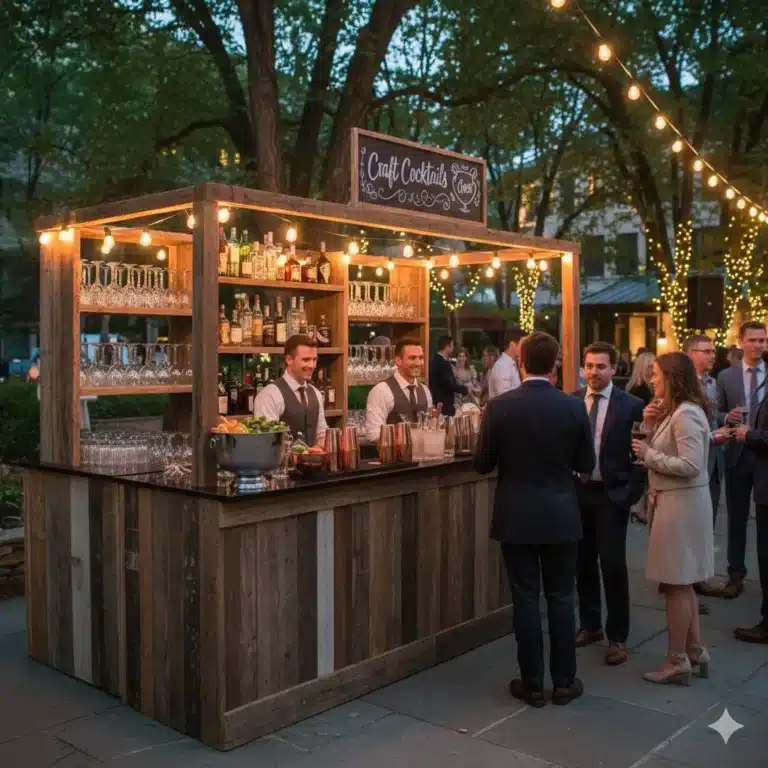
When the bar needs to carry the brand, photograph well, and feel built for the room, a custom piece earns its cost. We see this most on brand activations, flagship launches, and weddings where the bar anchors the design. A fabricated bar can be wrapped in your logo, backlit, topped in stone or live-edge wood, and shaped to fit a corner the catalog never accounted for.

Our custom bar fabrication work starts from the venue dimensions and the brand kit, not a stock SKU. If you want to see how a built-for-purpose bar changes the feel of a space, our breakdown of custom event bars and event design walks through real examples. For teams across the region, our custom bar rentals for NYC, CT, MA, and RI cover both the build and the logistics of getting it on site.

The honest caveat: custom means lead time. Plan four to six weeks minimum for design, build, and finish, longer if you’re sourcing specialty materials or integrating lighting.

Match the Finish to the Venue

A bar that fights its surroundings looks rented. A bar that echoes the venue looks intentional. Read the room’s materials and lighting before you lock a finish.

  • Industrial lofts and warehouse spaces (think Brooklyn and Long Island City): raw wood, blackened steel, exposed Edison bulbs. The bar should feel like it belongs to the building.
  • Ballrooms and hotels: lacquered fronts, stone or quartz tops, clean uplit panels. Polish reads as premium here.
  • Tented and outdoor events (common across Connecticut and the Cape): weather-tolerant surfaces and a back bar that won’t tip in wind. Stability beats flash outdoors.
  • Tech and product launches: backlit logo fronts and color-matched LED, tied into the rest of the lighting design.

The Part Nobody Photographs: Back Bar and Speed

The front of the bar wins on Instagram. The back of the bar wins on throughput. Once you’re pushing past roughly 200 drinks an hour per station, the difference between a smooth night and a stalled line is what’s behind the bartender, not in front of them.

Things that actually move drinks:

  1. Speed rails and a real back bar so bartenders aren’t reaching across each other for bottles.
  2. Ice capacity planned in pounds, not bags. A busy bar burns through far more ice than teams expect, and running out kills service.
  3. A pre-batched signature or two so the highest-volume order is a pour, not a build.
  4. A separate beer-and-wine or bubbly station to pull the simplest orders off the main bar entirely.

None of this shows up in photos, and all of it determines whether guests remember the event or the wait.

Lock the Decision Early

Bar style touches three timelines at once: fabrication, rental inventory holds, and, for some municipalities, the permit and licensing window for service. When any one of those slips, the others follow.

Our practical deadline is four to six weeks out for the final bar count and style, earlier if you’re going fully custom or your event lands in peak season (May through October across the Northeast). Confirming early also locks your finish and footprint while your favorite inventory is still available, instead of settling for what’s left.

The bar isn't furniture. It's the busiest piece of production on the floor, and it should be specified like it.

Event Fab Team

Serving NY, CT, MA & RI

We design, build, and deliver event bars across New York City and the tri-state region, from Manhattan lofts and Brooklyn warehouses to Connecticut estates, Boston ballrooms, and Rhode Island waterfront venues. Whether you need a fast modular setup or a fully fabricated brand statement, we handle the build and the load-in so the bar is ready before doors open.

Not sure which bar your event needs?

Tell us your headcount, venue, and timeline, and we'll spec the right bar style and station count, then handle the build and delivery. Get a tailored quote for your event.
Request a Quote

Event Bar Rentals — Frequently Asked Questions

The questions brand and event teams ask us most when speccing bars for their events.
Contact Us

Tell Us About Your Project Or Event
