Custom Bars

Designing a Photo-Worthy Brand Bar

September 9, 2026 By Event Fab Team 9 min read

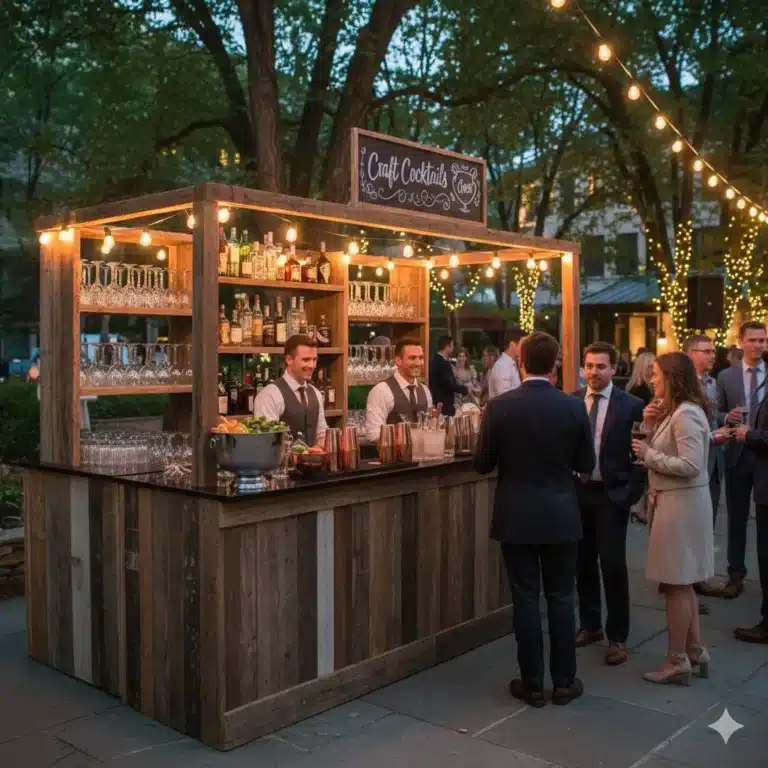
Every brand bar gets photographed. Not by your production photographer — by the two hundred guests standing in line with a phone in one hand. Those photos are the activation’s real distribution channel, and most of them get taken from the same three feet of floor, at the same eye level, under whatever light the venue happened to leave on. If the bar wasn’t designed for that frame, it doesn’t matter how good the renders looked.

This is a working guide to designing a bar that holds up in a vertical phone photo: how the backbar carries the brand, how to light it so cameras can actually read it, how the signature serve becomes a product shot, and what the lead times and budget bands look like when you build it right. It’s written for brand and agency teams scoping activations across New York, Connecticut, Massachusetts, and Rhode Island — where the venue, not the concept, usually decides what’s possible.
Key Takeaways

  • The photo frame is vertical and shot from 3-6 feet away — design the backbar, not the whole elevation, as the hero.
  • Budget 40-60 foot-candles of warm front light on the backbar; ambient venue light alone reads muddy on a phone sensor.
  • Keep the logo above 54 inches so it clears the heads of the people standing at the bar.
  • Custom fabricated bars need 4-6 weeks from approved drawings; modular rental bars with branded wraps can land in 10-14 days.
  • The signature serve — glassware, garnish, and a branded coaster or pick — is the cheapest photo upgrade on the whole build.

Design for the Frame Guests Actually Shoot

Walk any activation and watch where phones come out. It is almost never the wide elevation your design deck rendered. It is a vertical crop, taken from three to six feet back, that captures a drink in the foreground and the backbar behind it. Everything outside that rectangle is set dressing.

That changes the design priorities in a few concrete ways:

  • The backbar is the hero, not the bar face. The front of the bar is blocked by the guest’s own body and the drink in their hand. Brand equity belongs on the vertical surface behind the bartender.
  • Logos live above 54 inches. Below that, they disappear behind the heads of everyone standing at the rail. Above roughly 90 inches, they crop out of a phone held at chest height.
  • Design in portrait. A 9:16 crop of your bar should still read as branded. If the only place the mark appears is a wide horizontal band, it survives none of the photos guests actually post.
  • Watch what’s behind the shooter. A bright exit sign or a window 40 feet back will blow out every phone photo taken toward the bar. This is a site-visit question, not a design question.

We work through this frame-first on every build. For a broader look at how bar design fits alongside the rest of the activation build-out, see our overview of custom bar fabrication, which covers the structural and finish decisions that sit underneath the styling.

Backbar Architecture: Depth Beats Flatness

A flat printed wall behind the bar photographs like what it is — a printed wall. Depth is what separates a bar that looks fabricated from one that looks like a step-and-repeat someone leaned a shelf against. Three layers is the working minimum.

Layer one: the field

The background plane. Painted millwork, slatted wood, fluted panel, tile, or tensioned fabric. Keep the value mid-range — a very dark field swallows product, and a bright white field forces phone cameras to underexpose everything in front of it. Mid-tone warm neutrals and saturated brand colors both photograph well.

Layer two: the shelving and product

Floating shelves at 12-14 inches of spacing, holding bottles, glassware, and props. This is where the eye lands. Product should be faced and gapped, not packed — a shelf at 70 percent density reads as styled, a shelf at 100 percent reads as storage. Bottle labels should face out and align.

Layer three: the branded moment

The mark itself. Dimensional letters, a routed and backlit logo, a neon or faux-neon script, or an illuminated brand panel. Dimensional beats printed by a wide margin in photos, because it catches light and casts a shadow — that’s what makes a phone camera register it as an object rather than a graphic.

Backbars also do unglamorous work: ice, speed rail access, glass storage, waste, and cable management for anything illuminated. Budget 24-30 inches of working depth between the bar and the backbar so bartenders can turn without stepping out of the station. Our custom bar rental inventory across NYC, CT, MA, and RI includes backbar units sized to these clearances, which is usually faster and cheaper than fabricating from scratch when the brand expression can live in a wrap and a lit logo.

Lighting: The Single Biggest Photo Variable

More good bar designs are lost to lighting than to any other cause. Venue ambient light is typically 5-15 foot-candles at the bar face, which is enough to see by and nowhere near enough for a phone sensor to render color and texture cleanly. Under that, a beautifully finished walnut bar photographs as a brown smudge and your brand color shifts toward whatever the room’s LEDs are doing.

What actually works:

  • 40-60 foot-candles of front light on the backbar, at 2700-3000K. Warm reads as flattering; anything above 4000K makes skin tones go clinical and guests will not post the photo.
  • Light the product, not the wall. Under-shelf LED tape at roughly 1.5 to 2 watts per foot, tucked behind a 3/4-inch lip so the source is hidden. Visible diodes create hot spots that ruin every frame.
  • Separate the logo circuit. Backlit or edge-lit marks should dim independently. What looks right at 6 p.m. daylight is blinding at 10 p.m.
  • Add a soft key on the guest side. A single pin spot or small wash aimed at the rail — where guests hold their drink — is what makes the serve look good. Without it the drink is a silhouette.
  • Avoid pure color washes on the backbar. Deep blue or magenta wash makes white phone balance impossible. Use color on adjacent surfaces and keep the bar itself close to neutral-warm.

Power is the constraint that surprises people. A modest lit backbar draws 300-600 watts; add a refrigeration unit and you’re sharing a 20-amp circuit with the bartender’s blender. Confirm circuit availability and distance to the nearest distro during the site visit, not during load-in.

The Signature Serve Is Your Product Shot

Guests photograph the drink far more often than the bar. The drink is portable, it fits the frame, and it’s the thing they were handed. Treating the serve as a design deliverable — not a catering decision — is the highest-return move in the entire budget.

The components worth specifying:

  • Glassware with a silhouette. A coupe, a nick-and-nora, a textured rocks glass, or a copper vessel photographs. A standard clear highball does not. Rental glassware upgrades typically run $1.50-$4.00 per piece.
  • One garnish with vertical presence. A dehydrated citrus wheel, a sprig, an expressed peel. It gives the camera something to focus on and it breaks the flat plane of the liquid surface.
  • A branded touchpoint on the vessel. A custom pick, a printed coaster, a clip-on tag, or an edible logo topper. Cost is measured in cents; it puts the mark inside every drink photo.
  • Color contrast against the bar top. An amber cocktail on a walnut bar disappears. Either shift the drink color or spec a lighter serving surface — a marble or terrazzo tray at the pickup point solves it for about $200.
  • A designated pickup spot. One lit, uncluttered 18-inch square where finished drinks are placed. Guests will photograph there because it is the only clean surface. Make sure the brand mark is in that background.

Two to three signature serves is the right number. More than that slows the line, and line length is a photo problem as much as a hospitality one. For examples of how this comes together on real builds, our guide to custom event bars and event design walks through several configurations and the reasoning behind each.

Footprint, Flow, and the Line That Wrecks the Frame

A twelve-person queue in front of your bar means nobody can photograph the bar. Throughput is a design constraint, and the numbers are unforgiving.

Working planning figures we use:

  • One bartender per 75-100 guests for a beer-wine-and-one-cocktail program; one per 50-60 if you’re running multiple built cocktails.
  • Six linear feet of bar per bartender, minimum. Four feet works only for a pour-and-hand-off station.
  • Batch anything you can. A pre-batched cocktail on tap or in a chilled dispenser cuts serve time from 90 seconds to about 15, and it makes the presentation more consistent across the night.
  • Split the pickup from the order point at anything above 200 guests. It clears the rail, which is where the photos happen.
  • Leave a photo pocket. Four to six feet of open floor at a 30-45 degree angle off one end of the bar, out of the queue path. Guests will find it and use it.

Venue realities in the Northeast shape all of this. Manhattan lofts and Brooklyn warehouse spaces often have a single service elevator with a 7-foot cab, which caps your maximum panel dimension before anything is built. Boston’s Seaport venues and many Connecticut country clubs run load-in windows of four hours or less. Newport properties frequently restrict wall attachment entirely, which pushes the backbar to a freestanding structure with a weighted base. You can see a range of completed builds in our event showcase.

Lead Times, Budget Bands, and What to Lock First

Nothing on a bar build breaks the timeline like a late finish decision or a logo file that arrives in the wrong format. Here is the realistic schedule.

Lead times

  • Modular rental bar with branded vinyl wrap: 10-14 days from approved artwork.
  • Rental bar plus custom backbar: 3-4 weeks.
  • Fully custom fabricated bar and backbar: 4-6 weeks from approved shop drawings — and drawings themselves take 5-10 business days after design sign-off.
  • Illuminated or dimensional logo elements: add 2 weeks; specialty neon or complex acrylic add 3.
  • Permits, where required (outdoor bars, sidewalk activations, certain NYC venues): 3-6 weeks, and this runs in parallel but cannot be compressed.

Budget bands

  • $3,000-$6,000: Rental bar, branded wrap, basic under-shelf lighting, glassware upgrade.
  • $8,000-$15,000: Rental bar with a custom-fabricated backbar, dimensional lit logo, styled product, dedicated lighting package.
  • $18,000-$40,000+: Fully custom bar and backbar with specialty finishes, integrated refrigeration, custom millwork, and full lighting and power design.

Lock these three things first, in this order: overall footprint and orientation (it depends on the venue and cannot change late), vector logo files with confirmed Pantone values, and the finish schedule. Everything else — product styling, garnish spec, signage copy — can move until roughly ten days out. When you’re ready to put numbers against a specific venue and guest count, request a quote and we’ll scope the build, the lighting, and the install window together.

The bar you designed and the bar guests photograph are two different objects. Design the second one.

Event Fab Team

Serving NY, CT, MA & RI

We fabricate, deliver, and install branded bars across New York, Connecticut, Massachusetts, and Rhode Island — from Manhattan loft activations with 7-foot freight elevators to Newport waterfront properties where nothing can touch a wall. Our shop builds to the venue's actual constraints, and the same crew that builds it runs the install.

Let's Design a Bar Worth Photographing

Send us the venue, the guest count, and the date. We'll come back with a footprint, a lighting plan, and a build schedule that fits your load-in window.
Request a Quote

Photo-Worthy Brand Bars — Frequently Asked Questions

The questions brand and agency teams ask us most often when scoping a branded bar build.

Four to six weeks from approved shop drawings for a fully custom build, and drawings take another 5-10 business days after design sign-off. Practically, that means starting the conversation about eight weeks out. If you’re inside four weeks, a modular rental bar with a branded wrap and a custom backbar element is the realistic path — that lands in 10-14 days.

A printed backdrop photographs as a printed backdrop. It’s flat, it doesn’t catch light, and phone cameras render it as graphic rather than object. If budget forces a choice, spend on one dimensional lit logo element in front of a simple painted or fabric field rather than a full-width high-resolution print. The dimensional piece does more work in every photo.

Ask for 40-60 foot-candles on the backbar at 2700-3000K, a separately dimmable circuit for any illuminated logo, and one soft pin spot on the guest-side rail. Confirm a dedicated 20-amp circuit within cable reach if you have refrigeration or more than about 500 watts of lighting. Get all of it in writing before load-in day.

One bartender per 75-100 guests for a simple program, or one per 50-60 for multiple built cocktails, with six linear feet of bar per bartender. Batching your signature serve cuts serve time from roughly 90 seconds to 15 and is the single most effective way to keep the queue short — which is also what keeps the bar visible in photos.

Yes, if it’s designed for it from the start. That means panelized construction sized to a 7-foot freight cab, cam-lock or French-cleat connections instead of screws, a weighted freestanding backbar that never needs wall attachment, and a road case per section. It adds roughly 15-25 percent to the build cost and pays back after the second market.

Venue name and address, guest count, event date and load-in window, vector logo files with Pantone values, and any brand guidelines covering finish and color. If you have venue floor plans and a loading dock spec, send those too — they usually answer half the design questions before we start.

Contact Us

Tell Us About Your Project Or Event

Which of our services are you interested in?*
Preferred Contact Method*
