Custom Bars

Outdoor Bar Rentals: What to Consider for Tent and Park Events

July 6, 2026 By Event Fab Team 9 min read

An outdoor bar looks effortless from the guest side: a cold drink handed over the moment someone reaches the rail. What makes it effortless is a stack of decisions made weeks earlier — where the power runs, how ice gets replenished, what happens when a June thunderstorm rolls across the Hudson at 6:15 on a 6:30 event. Tent and park venues strip away the plumbing, circuits, and walls that indoor bars take for granted, and every one of those has to be engineered back in.

This guide walks through what actually determines whether an outdoor bar rental holds up on the day: weatherproofing, power, and the ice and water logistics that quietly break more outdoor service than any design choice. If you plan events across NY, CT, MA, or RI, these are the questions to ask before you sign anything.
Key Takeaways

  • Confirm power early: a single blended-drink station can pull 1,500+ watts, and park venues rarely have accessible outlets.
  • Plan roughly 1 to 1.5 lbs of ice per guest for a 4-hour bar, plus a shaded, draining holding zone.
  • Weatherproofing is a lead-time item — tent sidewalls, weighted bases, and a rain plan get locked 2 to 3 weeks out.
  • Grey water has to go somewhere; parks and many tents prohibit dumping, so budget for catch containers or a service line.
  • Permit windows for park and public-space events in the Northeast often run 3 to 6 weeks — start there, not with the bar design.

Weatherproofing: Design for the Day You Don't Want

Outdoor bars fail in weather at the seams, not the surface. A beautiful bar front means nothing if the back-of-house station is exposed and your bartenders are working in wind-driven rain. Weatherproofing an outdoor bar is really three separate problems: keeping the service crew and product dry, keeping the structure stable, and keeping electrical connections safe.

Cover and containment

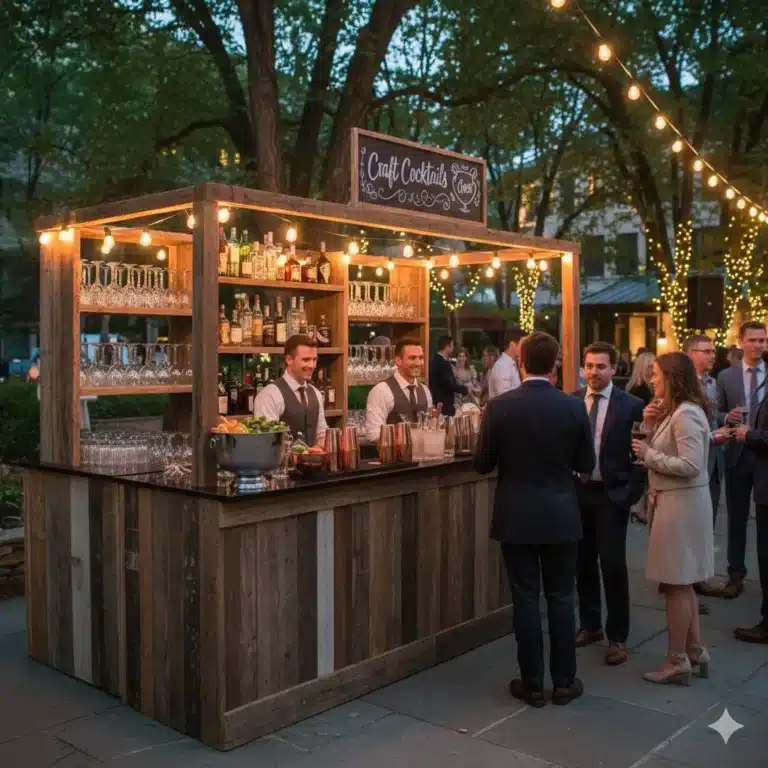
Under a tent, position the bar so the working side sits well inside the sidewall line — not at the edge where blowing rain reaches it. For open-air park setups, a dedicated bar canopy or a run of outdoor event structures gives you a defensible dry zone for garnish, glassware, and point-of-sale.

Stability and wind

  • Weight everything. Freestanding bars, backdrops, and menu signage need weighted bases or stakes rated for the venue. Coastal RI and Cape Cod events see gusts that will walk an unweighted bar across the lawn.
  • Sidewalls are a decision, not an afterthought. Clear or solid tent sidewalls change airflow, temperature, and rain exposure — decide 2 to 3 weeks out so the rental is reserved.
  • Have a documented rain call. Know the exact time you’d drop sidewalls or shift the bar, and who makes that call.

Power: The Question Park Venues Punish You For Skipping

Indoors, you plug in. Outdoors, power is the single most common thing that turns a smooth bar into a stalled one. Blenders, frozen-drink machines, under-counter refrigeration, and even LED bar lighting all draw current, and park or open-field venues rarely have an outlet within a usable distance.

Do the load math first

Add up what each station actually pulls. A commercial blender or frozen-drink machine can draw 1,200 to 1,800 watts on its own; a small under-counter fridge adds a few hundred more. A standard 15-amp household-style circuit tops out around 1,800 watts, so a single frozen-drink station can consume an entire circuit. Two blended stations on one circuit will trip it mid-rush.

Where the power comes from

  • Venue distribution. Some tented estate and catering venues have panel access — confirm amperage and distance, not just that power ‘exists.’
  • Generator. For most true park events, budget a quiet inverter generator sized with headroom above your peak load, plus fuel for the full service window.
  • Cable management. Any run across guest paths needs rated cable ramps. This is both a safety and a permit item in NYC parks and many CT and MA municipalities.

If you’re pairing the bar with lighting or AV, size the generator for the whole footprint — the full outdoor event rentals package, not the bar in isolation.

Ice and Water Logistics: The Quiet Timeline Killer

Ice is where outdoor bars most often come up short, because the planning number is bigger than people expect and the resupply chain is longer. Indoors, you walk to a machine. In a park a quarter mile from the nearest vehicle access, every bag of ice is a logistics decision.

How much ice

For a 4-hour bar in warm weather, plan roughly 1 to 1.5 pounds of ice per guest — and lean to the high end for July and August across the region. That covers both drink ice and the ice needed to keep bottled product, beer, and mixers cold. A 150-guest summer event can easily need 200+ pounds.

Holding and melt

  • Shade the reserve. Ice held in sun melts fast; keep the holding supply in insulated bins in a shaded, out-of-traffic zone.
  • Plan the meltwater. Coolers and tubs drain — decide where that water goes so it isn’t pooling under the bartenders’ feet.
  • Sequence resupply. If access is tight, schedule a mid-event ice drop rather than trying to stage the entire day’s supply at once.

Fresh and grey water

Bartenders need clean water for rinsing and hand hygiene, and that used water has to be captured. Parks and many tent contracts prohibit dumping grey water on the grounds. Budget for sealed catch containers or, for larger programs, a serviced water station. It’s an unglamorous line item that keeps you compliant and keeps the venue willing to host you again.

Permits, Access, and the Northeast Reality

The bar design is the fun part; the permit and access questions are what decide your timeline. Public parks and many municipal spaces across NY, CT, MA, and RI require permits for events with alcohol service, structures, and generators — and those windows are longer than most teams assume.

  • Permit lead time. Park and public-space permits in the Northeast commonly run 3 to 6 weeks, and alcohol service can require a separate approval. Start here before you finalize the bar.
  • Load-in and access. Walk the route. How far from the nearest vehicle drop to the bar location? Are there stairs, gravel, or turf restrictions? This determines crew size and setup time.
  • Ground protection. Many parks require turf protection under heavy structures — another item to confirm early.

The teams that avoid day-of scrambles treat the bar as one component of a coordinated outdoor build. If you’re already planning tenting or staging, fold the bar into the same structural and power plan rather than sourcing it separately.

Design That Survives the Elements — and Still Looks Custom

None of this means outdoor bars have to look utilitarian. The strongest outdoor bars pair a weather-smart build with a finish that carries the brand or event aesthetic. Materials matter here: sealed surfaces, UV-stable graphics, and hardware that won’t corrode after one humid coastal event.

  • Modular footprints let you scale the bar to the guest count and reconfigure if the layout shifts on-site.
  • Integrated lighting extends usability into the evening — but loops back into your power plan.
  • Branded fronts and backdrops turn the bar into a photo moment, not just a service point.

For a deeper look at how bar design drives the whole guest experience, see our breakdown of custom event bars and how they elevate event design. The same principles apply outdoors — you’re just engineering them to hold up against sun, wind, and resupply constraints.

Outdoor bars don't fail on design — they fail on power, ice, and the rain plan nobody wrote down. Engineer those first and the beautiful part takes care of itself.

Event Fab Team

Serving NY, CT, MA & RI

We build and deliver outdoor bars for tent, estate, waterfront, and park events across New York, Connecticut, Massachusetts, and Rhode Island. That regional footprint means we plan for the specifics — NYC park permitting, coastal wind on the RI and Cape shoreline, and the load-in realities of estate venues in Westchester and Fairfield County — before they become day-of problems.

Planning an Outdoor Bar? Let's Engineer It Right

Tell us the venue, guest count, and date, and we'll help you scope the bar, power, weatherproofing, and ice logistics as one coordinated build across NY, CT, MA, and RI.
Request a Quote

Outdoor Bar Rentals — Frequently Asked Questions

The questions brand and agency teams ask most when planning bar service for tent and park events in the Northeast.
Contact Us

Tell Us About Your Project Or Event
