Event Tips

The Complete Holiday Party Planning Guide for Brands

September 7, 2026 • By Event Fab Team • 9 min read

Holiday party season is the one window where nearly every brand in the Northeast competes for the same venues, the same production crews, and the same three weeks on the calendar. The team that books in July gets a real room with a loading dock. The team that books in October gets a hotel ballroom with a low ceiling and a $12,000 minimum on a bar they didn’t want.

This is the production-side playbook: when to lock each decision, what a corporate holiday party actually costs once fabrication and labor are in the number, and which choices quietly determine whether the room feels like a company obligation or something people talk about in January.
Key Takeaways

  • Venue holds should be signed 5–6 months out; December Fridays in Manhattan are typically gone by late August.
  • Custom fabrication needs 6–8 weeks from approved drawings — not from the day you decide you want it.
  • Budget roughly 35–45% to food and beverage, 20–30% to venue, and 20–25% to production, design, and rentals.
  • Union or house-labor venues can add 25–40% to install costs; confirm the labor rules before you sign, not after.
  • One strong built moment — an entrance, a bar, a photo environment — outperforms decorating the whole room evenly.

The Real Holiday Timeline (Working Backward From December)

Most holiday party problems are timeline problems wearing a budget costume. The cost spike teams complain about in November is the price of compressed lead time: rush fabrication, overtime install, last-minute rental sourcing from a second or third vendor.

Six months out (June–July)

  • Set the headcount range and the all-in budget ceiling. Everything downstream keys off these two numbers.
  • Tour and hold venues. Ask about load-in hours, freight elevator dimensions, ceiling height, and rigging points on the tour — not in a follow-up email.
  • Decide whether this is a seated dinner, a roaming reception, or a hybrid. That single choice changes venue size by 30–40% per guest.

Four months out (August–September)

  • Sign the venue. Confirm in writing whether house labor is required for install.
  • Lock the creative direction and get renderings. This is when custom event fabrication enters the schedule — scenic walls, bars, entry structures, and branded environments all need drawings before they need a shop.
  • Book entertainment. Good bands and DJs in the Northeast are booked for December by early fall.

Eight to ten weeks out (October)

  • Approve fabrication drawings. Once approved, the shop needs 6–8 weeks — this is the single hardest deadline on the schedule.
  • Finalize the menu and bar package. Tasting happens here, not in November.
  • Confirm rentals: furniture, linens, glassware, lounge groupings. Inventory in the Northeast tightens sharply after mid-October.

Three weeks out

  • Final headcount to the caterer. Production schedule and run-of-show distributed.
  • Site walk with the production lead, venue contact, and anyone touching install.
  • Certificates of insurance filed. Venues will not let a truck in the door without them, and this is the most common day-of failure we see.

What a Corporate Holiday Party Actually Costs

Per-guest numbers get quoted loosely, so here are working bands for the Northeast market — New York metro at the top, Connecticut, Massachusetts, and Rhode Island generally running 15–25% below Manhattan for comparable quality.

  • Straightforward reception, 100–150 guests: $175–$275 per person all-in. Venue, passed food, open bar, basic lighting, minimal build.
  • Seated dinner with design, 150–300 guests: $300–$500 per person. Real florals, custom linens, a designed room, a band.
  • Full-production event, 300+ guests: $500–$900+ per person. Custom scenic, staging, video, a fabricated bar or entry moment, full lighting design.

Two costs consistently surprise first-time planners. The first is labor: at union venues and many hotels, house crew is mandatory, and a build that costs $8,000 in the shop can carry $6,000 in install. The second is overtime — venues that only release the room at 4pm for an 7pm start force a compressed load-in, and compressed load-ins are priced at a premium.

If the budget is genuinely tight, cut scope rather than quality. A smaller guest list in a better room with one well-built feature beats a large event that feels thin everywhere.

Venue Selection: The Questions That Actually Matter

Photos sell rooms. Logistics run them. Before falling for a space, get answers to these:

  1. What are the load-in hours, and is there a freight elevator? A gorgeous fourth-floor loft with a passenger elevator rules out anything you can’t carry by hand.
  2. What’s the ceiling height, and where are the rigging points? Ceiling height determines whether lighting can do anything interesting. Under 12 feet, you are decorating at eye level.
  3. Is house labor required? This is the 25–40% line item nobody budgets for.
  4. What’s the true capacity for your format? A room rated 300 for a reception holds maybe 180 seated with a dance floor and a band.
  5. What’s the power situation? Lighting, kitchen, and AV competing on the same circuits is how a room goes dark at 9:40pm.

Regionally, the calendar behaves differently by market. Manhattan December Fridays and Saturdays are effectively gone by late summer. Brooklyn and Long Island City industrial spaces hold longer but book fast once Manhattan fills. Connecticut’s Fairfield County and Greater Boston stay open into September. Rhode Island and Newport properties are the most available — and often the best value for a company willing to make the drive.

If you’re weighing formats more broadly, our corporate events production services page breaks down how different event types change the venue math.

Design That Doesn't Read as Generic Holiday

The default holiday party looks the same everywhere: red and gold, a tree in the corner, uplights on the walls. It’s fine. It’s also forgettable, and it does nothing for a brand that spent six figures on the evening.

The alternative is to build a small number of things well:

  • The entrance. The first fifteen feet set the expectation for the entire night. A fabricated entry portal, a tunnel, or a designed threshold does more work than anything else in the room.
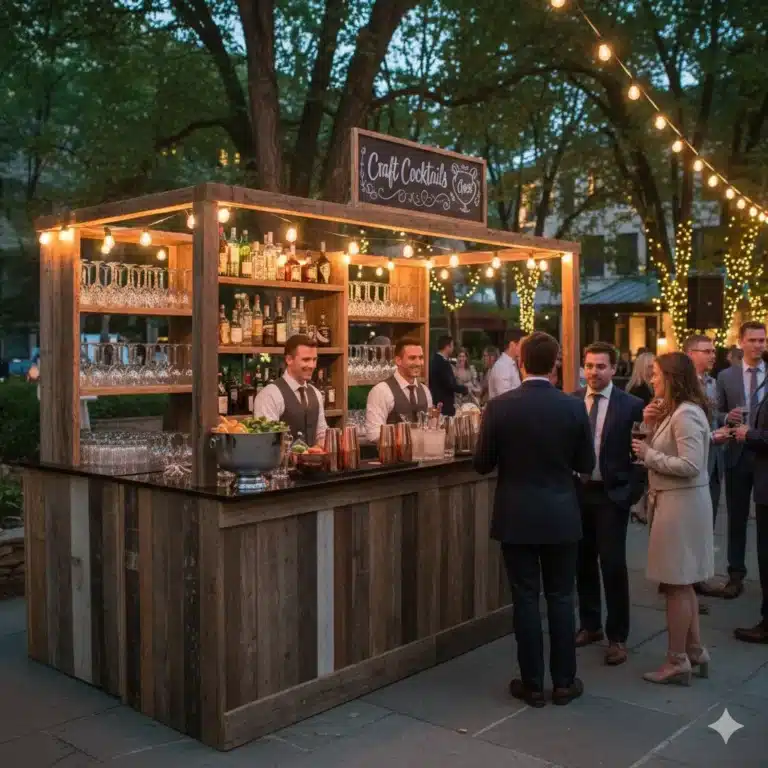
  • The bar. Guests spend more time at the bar than anywhere else. A custom-built bar with brand-integrated materials is the highest-traffic branded surface at any event.
  • One photo environment. Not a step-and-repeat against a wall — an actual designed moment people want to stand in.
  • Lighting as architecture. Well-designed lighting reshapes a mediocre room. Bad lighting makes a beautiful room look like a conference breakout.

Skip the even distribution. Three strong moments beat forty decorated square feet of nothing in particular.

For the mechanics of how built elements get designed, drawn, fabricated, and installed, our complete corporate event production guide walks through the full process end to end.

Northeast Winter Logistics Nobody Budgets For

December in the Northeast introduces variables that don’t exist in June, and they belong in the plan rather than in the incident report.

  • Weather contingency. A snow event the week of your party is a real possibility from Boston to Hartford to New York. Ask the venue about a postponement clause before signing, and know what the caterer’s cancellation terms are.
  • Coat check. For 250 guests in winter you need real coat check infrastructure and at least two attendants. Underscoping this creates a 20-minute line at the exact moment everyone leaves.
  • Guest arrival. Manhattan in December means traffic. Build a 30-minute arrival window into the run-of-show rather than a hard start time.
  • Load-in weather. Trucks, salted sidewalks, and finished scenic materials do not mix. Protected load-in matters more in December than any other month.
  • Crew availability. Production labor across NY, CT, MA, and RI is at peak demand the first three weeks of December. Crew gets booked, not just venues.

Running the Night: A Working Run-of-Show

The single best predictor of whether a holiday party feels good is whether it has shape. Events that run as one undifferentiated block of cocktail hour lose the room by hour two.

A structure that reliably works for a 7:00–11:00 evening:

  • 7:00–8:00 — Arrival and reception. Passed food immediately; nobody should stand empty-handed. Music present but conversational.
  • 8:00–8:15 — Leadership remarks. Fifteen minutes, hard stop. Every minute past that costs energy you cannot get back.
  • 8:15–9:30 — Dinner or stations. Lighting warms. This is the social core of the evening.
  • 9:30–10:45 — The room shifts. Lighting drops, music changes, the dance floor opens. This transition should be deliberate and visible.
  • 10:45–11:00 — Late bite, coat check staffed up, clear exit.

Two rules worth enforcing: keep speeches short, and never schedule remarks after the dance floor opens. Once the room’s energy turns social, pulling it back for a presentation ends the night early.

The teams that get the best holiday parties aren't spending the most — they're deciding earliest and building fewer things better.

Event Fab Team

Serving NY, CT, MA & RI

We produce corporate holiday events across the Northeast — Manhattan lofts and Brooklyn industrial spaces, Fairfield County and Hartford-area venues in Connecticut, Boston and the surrounding Massachusetts market, and Providence and Newport in Rhode Island. Our shop fabricates in-house and installs regionally, which means a custom bar or entry build in Stamford runs on the same schedule discipline as one in Midtown. December calendars fill from the top of the market down, so earlier conversations consistently produce better rooms at better numbers.

Start Your Holiday Party Planning Now

Tell us your headcount range, target date, and budget ceiling, and we'll come back with venue direction, a realistic production schedule, and what's actually buildable in the time you have. The earlier the conversation, the more the calendar works in your favor.
Request a Quote

Corporate Holiday Party Planning — Frequently Asked Questions

The questions brand and agency teams ask us most often when planning holiday events across the Northeast.

Five to six months for venue, which means June or July for a December date. Manhattan December Fridays and Saturdays are largely gone by late August. Connecticut, Massachusetts, and Rhode Island venues hold availability a few weeks longer, but the good rooms in every market follow the same curve. If you’re inside eight weeks, expect to compromise on either date, venue, or build scope.

A solid reception runs $175–$275 per person all-in. A seated dinner with real design lands at $300–$500. Full-production events with custom fabrication, staging, and lighting design start around $500 and go up from there. Manhattan sits at the top of each band; Connecticut, Massachusetts, and Rhode Island typically run 15–25% below for comparable quality.

Six to eight weeks from approved drawings for most scenic elements — bars, entry structures, branded walls, and built photo environments. Design and approval typically add another two to three weeks before that. Rush work is possible inside four weeks but carries a meaningful premium and narrows your material options.

Often yes, and it can be a strong choice — it removes venue cost and makes the budget go further on food, production, and build. The constraints to check first are power capacity, whether the freight elevator can handle build materials, building management rules on after-hours access and alcohol, and whether the space can be reset for business the next morning. We’ve built full environments into working offices across NY and CT where the room was back to normal by 8am.

Spreading the budget evenly across the entire room. The result is an event where nothing is bad and nothing is memorable. The stronger move is to concentrate spend on two or three built moments — the entrance, the bar, one photo environment — and let the rest of the room be clean and well-lit. Second-biggest mistake: speeches that run past fifteen minutes.

Address it in the contracts before you need to. Ask the venue for a weather postponement clause, understand the caterer’s cancellation window (often 72 hours for full charges), and confirm whether deposits are transferable to a new date. Fabricated elements are generally storable and reusable, so the build isn’t the exposure — food, labor, and venue are. We also plan protected load-in for December installs so finished materials never sit in weather.

Contact Us

Tell Us About Your Project Or Event

Which of our services are you interested in?*
Preferred Contact Method*